The 30th anniversary edition of the Dancing on the Edge Festival concluded last night with a 9 pm replaying of the Edge Seven program, a suitable study in contrasts featuring two distinctive approaches to movement and sound.
My colleague Rob Kitsos, together with collaborators Yves Candau and Martin Gotfrit, lead things off with their Real-Time Composition Study. Based on their shared interest in improvisation, the performers compose our perceptual environment in the moment, moving their bodies and sound through the space in response to each other, and to shifting geometric patterns of light that play across an upstage screen. While lighting designer Kyla Gardiner is in the booth overseeing all of this, much of the manipulation of light also happens from the stage, with Rob repositioning and partially shuttering and unshuttering a series of small LED spots in order to frame different areas of bodily focus. The result produces some uncanny trompe l'oeil effects, in which the shadows cast by the performers merge in such a way as to make one doubt whose limb is whose. Likewise, sound is often made to travel through space in a what initially appears to be an "unsourced" or acousmatic way, with Martin--and sometimes Rob--starting to play an instrument offstage that one thinks one can identify, only to emerge with something percussive or stringed or wind-based that totally upends such expectations.
The second piece on the program was Pathways, by Vision Impure's Noam Gagnon. Reworking a series of past solos into a large ensemble creation that Noam has set on eight young dancers whose ranks collectively represent some of the best talent to emerge from Vancouver's three main pre-professional dance programs (at Arts Umbrella, Modus Operandi, and SFU's School for the Contemporary Arts), the piece is performed to a pounding industrial score by Guillaume Cache. Clad all in black, and wearing matching knee-pads, the dancers hover outside the taped-off square of the main stage space, eyeing each other up and down like they are gladiators--or professional wrestlers. And, sure enough, once Eowynn Enquist (who has certainly been busy this festival) takes a running start and throws herself diagonally across the square, sliding to a stop on the other side, we are off on a non-stop contest of pure physicality. This is classic Gagnon choreography from his Holy Body Tattoo days: extreme, high energy, and punishingly visceral. We register the speed and impact of every body roll, the repeated jolts of limbs being thrown over and over again into the air (that five of the six women have long loose tresses that Noam shakingly exploits gives everything that much more of a rock and roll feel). The relentless kinetic and aural assault on our senses is almost overwhelming, but at a certain moment Noam shifts registers, with the dancers who seemed previously to be in competition, or just trying to run away from each other, now seeking each other out in a series of duets whose vocabulary of bodily climbing suggests that in this world even intimacy and tenderness can only be expressed in a similarly intense way.
Following some mixing with friends and artists in the community at DOTE's closing party, Richard and I (and several others circulating throughout the Firehall lobby and on its patio) headed north a few blocks to a warehouse space in Railtown owned by designer Omer Arbel to take in a midnight showing of Transverse Orientation, a new work of dance by Rachel Meyer. This is the second work of original choreography from the former Ballet BC dancer, who has only recently come back from maternity leave, looking impossibly lithe and limber. Based on the flight patterns of moths, and in particular how those patterns are oriented by and towards different natural and artificial sources of light, Transverse Orientation features: fellow Ballet BC alum Christoph von Riedemann as a lone moth-man figure, whose slow, calendrically-marked progress down a vertical runway frames the beginning and end of the piece (we move from watching his initial improvisations in a pre-show anteroom to the main playing space, from which we can track his progress towards us through a canny use of lighting and mirrors); Stéphanie Cyr, Ria Girard and Maya Tenzer as a trio of moths whose various bodily metamorphoses--from bumpy, fluttery proximity to grander, more swooping arcs of circular movement--are tracked through accompanying costume changes; and Meyer herself as a kind of queen moth figure (if I'm not mixing my insect metaphors), whose oversight of the proceedings progresses, transversally one might say, from semi-removed metteur-en-scène to fully engaged primum mobile, around which the others now must move--including violinist Janna Sailor, whose live playing is a key ingredient of the piece, and also eventually von Riedemann, who joins Meyers for a concluding duet that read a little too obviously as a mating dance.
For a self-produced show, Transverse Orientation has certainly spared no expense (including on its programs). Rigging up the lighting (by James Proudfoot) and configuring the set design (by Meyer herself) requires ample resources, and the apple budget alone must have been significant. As per the dramaturgical function of those apples, Meyer certainly has some sharp choreographic instincts. Fragments of the piece are individually compelling, particularly when Meyer is working with smaller, almost micro-movements: I'm thinking especially of von Riedemann's opening gestural sequence, and also Meyer's own fluttering responses to Sailor's improvised plucking and bowing--the way she can pulse a single shoulder blade, or infinitesimally shift the position of a bone in her foot is kind of amazing. That said, the fragments don't add up to a coherent whole and in seeking to interpret different aspects of moths' behaviours (why, for example, in their nocturnal attraction to artificial light, they frequently end up bumping against transparent surfaces, leaving a trail of dust from their wings), the movement comes across as mostly mimetic. I think the piece as it stands is also too long. But just as I always looked forward to what Meyer could do as a singularly virtuosic dancer on the Queen E stage, so do I anticipate great things from her in her new career as a choreographer.
P
Showing posts with label Noam Gagnon. Show all posts
Showing posts with label Noam Gagnon. Show all posts
Sunday, July 15, 2018

Thursday, April 19, 2018
The Explanation at The Cultch
Fresh off a standout performance in the Arts Club's recent production of Jitters (which I blogged about here), James Fagan Tait premiered his new play, The Explanation, at The Cultch's Culture Lab last night. Tait, who also directs this frank theatre production, highlights in his program notes the rather ironical premise of what is his first queer-themed show: how two straight men should end up married to each other.
Wearing a black wig, miniskirt, and combat boots, John (Kevin MacDonald), begins the account with a long opening monologue about how he started dressing up in women's clothes. The wondrous discovery of his inner femininity in a Value Village changing room occasions in John more than a simple outward transformation. While it's not always clear that it's being done consciously, Tait is deft in these opening passages in telegraphing some of the paradoxical non-alignments of gender expression and sexual identification. Which is also to say that when John puts on women's clothes, feminist solidarity doesn't automatically usurp a sense of masculine entitlement. For example, after he starts venturing out in public cross-dressed, John tells us he likes that men are staring at his ass, the sense of power this gives him--which is, on one level, just a reinforcing of the power he already had. And while he begins by correcting himself whenever he refers to himself as a "girl," amending this to "woman," eventually this pretence is dropped and thereafter John takes special delight in self-identifying as a "big ol' girl."
Eventually John, who lives in Burnaby, starts venturing downtown to the central branch of the Vancouver Public Library every Saturday in drag. (The timeframe of the play is a little fuzzy; there are several references to "pre-Yaletown" Vancouver, but other descriptions suggest that the VPL central branch being referred to is the one now at Homer and Robson.) On one such Saturday, while browsing among the Literature DVDs section, John meets Dick (Evan Frayne), who tells us in his opening monologue that when he first spied John he immediately thought: "This is the kind of woman who would go out with me." So Dick asks John to coffee and John says yes and in that moment Dick discovers that John is a man. But they have coffee anyway and the awkward thrill of this semi-public conversation liberates an additional something in each of them, which is how they end up dancing at a gay club on Davie Street later that night. Here, with the aid of Noam Gagnon's perfectly calibrated choreography, which mixes Dick's awkward straight white man's shuffle with John's unleashing of his inner diva, the two men cement their bond (James Coomber's on point sound design also helps to add great comic texture to these scenes). Soon a regular Saturday routine is established and a relationship is formed.
For questions of sexual identity and conjugality aside, what we are witnessing over the course of the play is at base the slow and by no means always smooth formation of a deep affective bond, and one that completely blows up the typical conventions of the bromance genre. Which is partly why I was disappointed in the rather conventional ending to the play. When, after mixing up their regular weekend pattern by having Dick cross-dress instead of John, the two men have drunken sex together, a crisis of identification threatens to destroy their friendship: are they gay, the two men muse separately to the audience. And does that even matter? Sorting through these questions, the men discover that they do in fact want to be together, including sexually. But not including drag. The final image is of John and Dick, dressed in suits, telling us not just that they've gotten married, but also that they've adopted two children. In its aping of what queer sociologist Lisa Duggan has diagnosed as the new "homonormativity," this scene actually entrenches the heternormative foundations of the two men's identities.
John and Dick were far more radical queer outlaws in their single days dancing up a storm in women's clothes.
P
Wearing a black wig, miniskirt, and combat boots, John (Kevin MacDonald), begins the account with a long opening monologue about how he started dressing up in women's clothes. The wondrous discovery of his inner femininity in a Value Village changing room occasions in John more than a simple outward transformation. While it's not always clear that it's being done consciously, Tait is deft in these opening passages in telegraphing some of the paradoxical non-alignments of gender expression and sexual identification. Which is also to say that when John puts on women's clothes, feminist solidarity doesn't automatically usurp a sense of masculine entitlement. For example, after he starts venturing out in public cross-dressed, John tells us he likes that men are staring at his ass, the sense of power this gives him--which is, on one level, just a reinforcing of the power he already had. And while he begins by correcting himself whenever he refers to himself as a "girl," amending this to "woman," eventually this pretence is dropped and thereafter John takes special delight in self-identifying as a "big ol' girl."
Eventually John, who lives in Burnaby, starts venturing downtown to the central branch of the Vancouver Public Library every Saturday in drag. (The timeframe of the play is a little fuzzy; there are several references to "pre-Yaletown" Vancouver, but other descriptions suggest that the VPL central branch being referred to is the one now at Homer and Robson.) On one such Saturday, while browsing among the Literature DVDs section, John meets Dick (Evan Frayne), who tells us in his opening monologue that when he first spied John he immediately thought: "This is the kind of woman who would go out with me." So Dick asks John to coffee and John says yes and in that moment Dick discovers that John is a man. But they have coffee anyway and the awkward thrill of this semi-public conversation liberates an additional something in each of them, which is how they end up dancing at a gay club on Davie Street later that night. Here, with the aid of Noam Gagnon's perfectly calibrated choreography, which mixes Dick's awkward straight white man's shuffle with John's unleashing of his inner diva, the two men cement their bond (James Coomber's on point sound design also helps to add great comic texture to these scenes). Soon a regular Saturday routine is established and a relationship is formed.
For questions of sexual identity and conjugality aside, what we are witnessing over the course of the play is at base the slow and by no means always smooth formation of a deep affective bond, and one that completely blows up the typical conventions of the bromance genre. Which is partly why I was disappointed in the rather conventional ending to the play. When, after mixing up their regular weekend pattern by having Dick cross-dress instead of John, the two men have drunken sex together, a crisis of identification threatens to destroy their friendship: are they gay, the two men muse separately to the audience. And does that even matter? Sorting through these questions, the men discover that they do in fact want to be together, including sexually. But not including drag. The final image is of John and Dick, dressed in suits, telling us not just that they've gotten married, but also that they've adopted two children. In its aping of what queer sociologist Lisa Duggan has diagnosed as the new "homonormativity," this scene actually entrenches the heternormative foundations of the two men's identities.
John and Dick were far more radical queer outlaws in their single days dancing up a storm in women's clothes.
P
Sunday, May 28, 2017
Convergence at EDAM
EDAM's latest choreographic series is on at the Western Front through June 2. It features new works by Peter Bingham, Vanessa Goodman and Noam Gagnon.
Talking to Bingham and dancer Delia Brett at different points during the evening's intermissions, I learned that Convergence, the work by Bingham that opens the evening, is structured around a series of restrictions the choreographer has given his seven dancers, including Brett, Anne Cooper, Elissa Hanson, Walter Kubanek, Diego Romero, Renée Sigouin, and Olivia Shaffer. The restrictions involve spending at least thirty per cent of the fifteen-minute piece hugging one of the studio's two side walls (which is how we encounter the dancers when the work opens), hewing closely to a specific individual line in space, and only engaging in contact with another body or bodies when those lines converge. Within those and a few other parameters, the dancers are free to improvise as they wish and what results is in part an almost slow motion breaking apart of some of the key principles of contact improvisation: that is, the finding of another body in space and what does or does not happen gravitationally as a result of that encounter. Indeed, some of the most enjoyable moments for me in the piece came when two or more dancers converged upon each other and humorously paused to decide who was leading and who was following whom.
Goodman's Accumulating is a trio featuring the choreographer and dancers Karissa Barry and Alexa Mardon, and showcasing an impressive sound and visual design by loscil (aka, local electro-acoustic composer Scott Morgan). The work opens with the three dancers dispersed in space upstage. Goodman is perched atop a speaker stage right. Barry is seated on a chair stage left. And Mardon hovers stationary in the upstage right doorway, her upstretched hands appearing to grip the upper lip of its inside frame. At a certain point Mardon lets go of her grip, crosses the threshold into the studio space and begins a dynamic and hyper-kinetic ten-minute solo, one in which her arms, tellingly, seem to function like antennae, propelling her forward as if in search of another door frame to attach themselves to. While this is happening, Barry is slowly crumbling forward in her chair and Goodman is turning this way and that atop her speaker, as if she is a stuck toy dancer in a malfunctioning music box. As part of the soundscore, we hear about the physiological make-up of the heart as an organ, and a video of what looks like smoke circles and rings slowly starts to creep up the backstage wall. Mardon eventually comes to rest and Barry, who by this time is slumped on the floor in front of her chair, begins her own solo, only hers is more fluid and languid, with the movement issuing more from the pelvis, hips and legs. The two dancers eventually join in a mirrored duet, their movements not quite in unison, but their hitherto distinct vocabularies now meshing in a complementary and mutually sustaining way. It's hard not to think of the figure performed by Goodman as having a hand in bringing the other two dancers together, especially when they come to rest in a seated position on the floor just to the left of her station and then collapse backward in exhaustion. This is the cue for Goodman to begin a contained mechanical sequence of movements atop her speaker, which in turn reanimates the other two dancers, who are given a final coda downstage before helping to disappear each other in a replacement series of poses in that upstage right doorway.
Gagnon's between us--what a difference a day makes is also a trio and likewise has a fantastic commissioned score, this time something a bit more industrial by James Coomber. To thrashing guitar sounds, Graham Kaplan, who is positioned downstage right, bends at the waist and grinds his shoulders forwards and backwards with such violence that I was sure one was going to pop out of its socket. Meanwhile, starting from her spot upstage left Lara Barclay begins a slow sinuous all-body crawl across the backstage wall. Positioned centre stage with her back to the audience, Heather Dotto moves forward and backward like a robot, her torso also hingeing with whiplash speed in either direction. Indeed, the extremity of each of the performers' bodily contortions and both the repetitiveness and physical force with which they executed them over the course of the piece's twenty minutes are what registered most with me in between us. At different points Kaplan partners both Dotto and Barclay, but each connection seems to be structured as much on repulsion as on attraction, with Kaplan and Dotto shoving their pelvises together like magnets, but then arcing their upper bodies away from each other like evil laughing clowns. The implicit violence in the lifts that Kaplan performs with Barclay is later completed when Barclay, chasing after Dotto and Kaplan, throws herself backwards on the floor, a discarded third wheel. And, indeed, it is possible to read the work through the lens of a love triangle. But, really, it is enough of a kinetic high just to absorb each new jolt and shock that emerges from this talented force field.
P.
Talking to Bingham and dancer Delia Brett at different points during the evening's intermissions, I learned that Convergence, the work by Bingham that opens the evening, is structured around a series of restrictions the choreographer has given his seven dancers, including Brett, Anne Cooper, Elissa Hanson, Walter Kubanek, Diego Romero, Renée Sigouin, and Olivia Shaffer. The restrictions involve spending at least thirty per cent of the fifteen-minute piece hugging one of the studio's two side walls (which is how we encounter the dancers when the work opens), hewing closely to a specific individual line in space, and only engaging in contact with another body or bodies when those lines converge. Within those and a few other parameters, the dancers are free to improvise as they wish and what results is in part an almost slow motion breaking apart of some of the key principles of contact improvisation: that is, the finding of another body in space and what does or does not happen gravitationally as a result of that encounter. Indeed, some of the most enjoyable moments for me in the piece came when two or more dancers converged upon each other and humorously paused to decide who was leading and who was following whom.
Goodman's Accumulating is a trio featuring the choreographer and dancers Karissa Barry and Alexa Mardon, and showcasing an impressive sound and visual design by loscil (aka, local electro-acoustic composer Scott Morgan). The work opens with the three dancers dispersed in space upstage. Goodman is perched atop a speaker stage right. Barry is seated on a chair stage left. And Mardon hovers stationary in the upstage right doorway, her upstretched hands appearing to grip the upper lip of its inside frame. At a certain point Mardon lets go of her grip, crosses the threshold into the studio space and begins a dynamic and hyper-kinetic ten-minute solo, one in which her arms, tellingly, seem to function like antennae, propelling her forward as if in search of another door frame to attach themselves to. While this is happening, Barry is slowly crumbling forward in her chair and Goodman is turning this way and that atop her speaker, as if she is a stuck toy dancer in a malfunctioning music box. As part of the soundscore, we hear about the physiological make-up of the heart as an organ, and a video of what looks like smoke circles and rings slowly starts to creep up the backstage wall. Mardon eventually comes to rest and Barry, who by this time is slumped on the floor in front of her chair, begins her own solo, only hers is more fluid and languid, with the movement issuing more from the pelvis, hips and legs. The two dancers eventually join in a mirrored duet, their movements not quite in unison, but their hitherto distinct vocabularies now meshing in a complementary and mutually sustaining way. It's hard not to think of the figure performed by Goodman as having a hand in bringing the other two dancers together, especially when they come to rest in a seated position on the floor just to the left of her station and then collapse backward in exhaustion. This is the cue for Goodman to begin a contained mechanical sequence of movements atop her speaker, which in turn reanimates the other two dancers, who are given a final coda downstage before helping to disappear each other in a replacement series of poses in that upstage right doorway.
Gagnon's between us--what a difference a day makes is also a trio and likewise has a fantastic commissioned score, this time something a bit more industrial by James Coomber. To thrashing guitar sounds, Graham Kaplan, who is positioned downstage right, bends at the waist and grinds his shoulders forwards and backwards with such violence that I was sure one was going to pop out of its socket. Meanwhile, starting from her spot upstage left Lara Barclay begins a slow sinuous all-body crawl across the backstage wall. Positioned centre stage with her back to the audience, Heather Dotto moves forward and backward like a robot, her torso also hingeing with whiplash speed in either direction. Indeed, the extremity of each of the performers' bodily contortions and both the repetitiveness and physical force with which they executed them over the course of the piece's twenty minutes are what registered most with me in between us. At different points Kaplan partners both Dotto and Barclay, but each connection seems to be structured as much on repulsion as on attraction, with Kaplan and Dotto shoving their pelvises together like magnets, but then arcing their upper bodies away from each other like evil laughing clowns. The implicit violence in the lifts that Kaplan performs with Barclay is later completed when Barclay, chasing after Dotto and Kaplan, throws herself backwards on the floor, a discarded third wheel. And, indeed, it is possible to read the work through the lens of a love triangle. But, really, it is enough of a kinetic high just to absorb each new jolt and shock that emerges from this talented force field.
P.
Thursday, March 23, 2017
Vancouver Dance History (2006-2016): Post 31
Earlier this morning Justine, Alexa and I gathered at The Dance Centre for our first group interview in a while. Our interviewee was Noam Gagnon and even before the conversation had officially begun he'd managed to tell us about two figures in the Canadian dance world whom, somewhat surprisingly, he had slept with. Then, when Alexa explained that we might use some of his gestures from the interview as part of a physical score Noam deliberately began pinching his nipples, rubbing his crotch and grabbing his ass. But it was the far more subtle gesture of Noam rubbing one arm with the hand of another while talking animatedly that I was most drawn to; he repeated it multiple times over the course of our interview and afterwards he explained that it was his gauge for telling the truth. If he could feel goose bumps on his arm then he knew he was being authentic; no bumps meant he was bullshitting. And there was certainly a lot of history for Noam to test his claims against.
As Noam mentioned, he started dancing relatively late, at the age of 19. Following a degree in visual art, which included a lot of performance-based and improvisation work, he appeared in a friend's dance recital and got hooked on movement. With no formal training, and at the time also speaking no English, he subsequently applied to Concordia University's Contemporary Dance Department, which uniquely focuses as much on choreographic process and creation/composition classes as it does on technique. Noam was accepted and there he studied with Elizabeth Langley, Michael Montanaro, Silvy Panet-Raymond, Jo Leslie, Martha Carter, and Andrew Harding, among others. In 1987, following the completion of his dance degree, Noam came west to tree plant; he said the experience was awful, but that it was while on a break in Vancouver between contracts that he saw an ad for auditions at EDAM, which was then still being co-directed (at this point by Peter Bingham, Lola McLaughlin, Jennifer Mascall, and Peter Ryan). Noam was accepted into the company, as was Dana Gingras, his future collaborator-in-crime at The Holy Body Tattoo (HBT). Noam spent two years at EDAM before relocating once again, this time to Ottawa to dance for Peter Boneham at Le groupe de la place royale. (Interesting side fact we learned from Justine: she took classes with Noam at Le groupe as a young high school dancer in Ottawa.)
Part of what attracted Noam to Le groupe was Boneham's desire to have him choreograph in addition to dance. And so alongside appearing in works by Boneham, Louise Bédard, Sylvain Émard, Ginette Laurin, Davida Monk, and Yvonne Coutts, among others, while at Le groupe Noam also came into his own as a choreographer. Already at EDAM he and Gingras were building a unique aesthetic together (to the point that Noam, with chagrin, admitted they were often openly disdainful of the work other choreographers were setting on them). Thus, Noam convinced Boneham to let Gingras be part of his last creation process at Le groupe, which became the piece L'Orage (1991). A year later the duo was back in Vancouver, had secured a 3000-square foot studio space (whose long and narrow L-shape configuration, according to Noam, accounted for the look of a lot of early HBT works), and had founded their company, which until 1999 included the composer Jean-Yves Thériault. For the next 16 years Noam and Gingras poured their bodies and souls into creating now legendary works like Poetry & Apocalypse (1994), our brief eternity (1996), Circa (2000), and Monumental (2005). HBT was known as much for their endless touring and inventive self-promotion as they were for the extreme physicality of the movement and their cross-disciplinary collaborations with music and film. But Noam revealed that he and Gingras were largely flying by the seats of their pants and creating opportunities for themselves the only way they knew how, which was spontaneously and without fear of the consequences (whether it be throwing all their money at a photoshoot and press kit, or maxing out a credit card for ten minutes at On the Boards in Seattle, or pretending to be producers in order to get meetings with European presenters). As Noam recalled that time, it all came from a boundless excitement and, in his words, a "thirst" to make the work, and to see where that work would take them.
Indeed, it took them all around the world, including Glasgow, where Noam recounted the horror of blanking completely on the choreography of our brief eternity during one performance and almost quitting dance as a result; and Sydney, Australia, where he and Susan Elliott both caught a bug on the plane and spent five days throwing up during rehearsal, only to power through their scheduled shows (also of our brief eternity) through sheer strength of will. (Interesting side fact number two: this is our third vomiting story so far in this project.) However, there came a point when Noam tired of life on the road, and where he and Gingras wished to move in different directions. And so in 2006 Noam formed Vision Impure as a platform to create solo work for himself, as well as to collaborate with other artists and choreographers, including the late Nigel Charnock (also a big influence on Tara Cheyenne Friedenberg) and Daniel Léveillé. (Around the same time, having practiced and taught Pilates for thirty years, he also established his Beyond Pilates Studio in the West End, knowing, as he said, there would come a point where he would have to retire from dance, but also wanting to keep himself healthy while still performing.)
Now after 10+ years making more intimate and conceptual-style works, Noam says he finds himself craving the opportunity to create larger-scale works for a bigger stage. But he's also tired of having to explain himself to presenters and granting agencies. As he put it, there remains within him a lot of thirst to explore and discover; but he doesn't have a lot of patience anymore for the institutional bullshit.
And certainly no one in this community is going to fault Noam, after the career he's had, for saying so. I just wish those in a position to do so would answer his call for change.
P.
As Noam mentioned, he started dancing relatively late, at the age of 19. Following a degree in visual art, which included a lot of performance-based and improvisation work, he appeared in a friend's dance recital and got hooked on movement. With no formal training, and at the time also speaking no English, he subsequently applied to Concordia University's Contemporary Dance Department, which uniquely focuses as much on choreographic process and creation/composition classes as it does on technique. Noam was accepted and there he studied with Elizabeth Langley, Michael Montanaro, Silvy Panet-Raymond, Jo Leslie, Martha Carter, and Andrew Harding, among others. In 1987, following the completion of his dance degree, Noam came west to tree plant; he said the experience was awful, but that it was while on a break in Vancouver between contracts that he saw an ad for auditions at EDAM, which was then still being co-directed (at this point by Peter Bingham, Lola McLaughlin, Jennifer Mascall, and Peter Ryan). Noam was accepted into the company, as was Dana Gingras, his future collaborator-in-crime at The Holy Body Tattoo (HBT). Noam spent two years at EDAM before relocating once again, this time to Ottawa to dance for Peter Boneham at Le groupe de la place royale. (Interesting side fact we learned from Justine: she took classes with Noam at Le groupe as a young high school dancer in Ottawa.)
Part of what attracted Noam to Le groupe was Boneham's desire to have him choreograph in addition to dance. And so alongside appearing in works by Boneham, Louise Bédard, Sylvain Émard, Ginette Laurin, Davida Monk, and Yvonne Coutts, among others, while at Le groupe Noam also came into his own as a choreographer. Already at EDAM he and Gingras were building a unique aesthetic together (to the point that Noam, with chagrin, admitted they were often openly disdainful of the work other choreographers were setting on them). Thus, Noam convinced Boneham to let Gingras be part of his last creation process at Le groupe, which became the piece L'Orage (1991). A year later the duo was back in Vancouver, had secured a 3000-square foot studio space (whose long and narrow L-shape configuration, according to Noam, accounted for the look of a lot of early HBT works), and had founded their company, which until 1999 included the composer Jean-Yves Thériault. For the next 16 years Noam and Gingras poured their bodies and souls into creating now legendary works like Poetry & Apocalypse (1994), our brief eternity (1996), Circa (2000), and Monumental (2005). HBT was known as much for their endless touring and inventive self-promotion as they were for the extreme physicality of the movement and their cross-disciplinary collaborations with music and film. But Noam revealed that he and Gingras were largely flying by the seats of their pants and creating opportunities for themselves the only way they knew how, which was spontaneously and without fear of the consequences (whether it be throwing all their money at a photoshoot and press kit, or maxing out a credit card for ten minutes at On the Boards in Seattle, or pretending to be producers in order to get meetings with European presenters). As Noam recalled that time, it all came from a boundless excitement and, in his words, a "thirst" to make the work, and to see where that work would take them.
Indeed, it took them all around the world, including Glasgow, where Noam recounted the horror of blanking completely on the choreography of our brief eternity during one performance and almost quitting dance as a result; and Sydney, Australia, where he and Susan Elliott both caught a bug on the plane and spent five days throwing up during rehearsal, only to power through their scheduled shows (also of our brief eternity) through sheer strength of will. (Interesting side fact number two: this is our third vomiting story so far in this project.) However, there came a point when Noam tired of life on the road, and where he and Gingras wished to move in different directions. And so in 2006 Noam formed Vision Impure as a platform to create solo work for himself, as well as to collaborate with other artists and choreographers, including the late Nigel Charnock (also a big influence on Tara Cheyenne Friedenberg) and Daniel Léveillé. (Around the same time, having practiced and taught Pilates for thirty years, he also established his Beyond Pilates Studio in the West End, knowing, as he said, there would come a point where he would have to retire from dance, but also wanting to keep himself healthy while still performing.)
Now after 10+ years making more intimate and conceptual-style works, Noam says he finds himself craving the opportunity to create larger-scale works for a bigger stage. But he's also tired of having to explain himself to presenters and granting agencies. As he put it, there remains within him a lot of thirst to explore and discover; but he doesn't have a lot of patience anymore for the institutional bullshit.
And certainly no one in this community is going to fault Noam, after the career he's had, for saying so. I just wish those in a position to do so would answer his call for change.
P.
Friday, February 24, 2017
The Mars Hotel and Kwan Yin at The Firehall
This week marks the return of Ziyian Kwan and dumb instrument Dance to The Firehall Arts Centre, this time in a presentation of Kwan's first full evening of dance. Included as part of the program is the return of The Mars Hotel, a piece based on a work of flash fiction by writer P.W. Bridgman that premiered on the same stage at the 2015 Dancing on the Edge Festival. An exuberant, whimsical, muscular and ultimately joyous ode to and deconstruction of that biggest of cliches, love, the work's many strange and delightfully askew set-pieces (including the deflating and blowing up of a giant white love ball) are structured around a duet Kwan performs with Vision Impure's Noam Gagnon.
In Gagnon Kwan has found her impish and physically fearless dance soulmate and I think this work remains such a hit with audiences in part because of the obvious improvisatory chemistry between both performers. Then, too, there is the crackerjack three piece musical ensemble, Handmade Blade, that accompanies the dancers on stage, including Aram Bajakian on electric guitar, JP Carter on trumpet, and the incomparable Peggy Lee on cello. You wouldn't normally think that a trio made up of these instruments would work, but their jamming last night (following a bit of a technical issue at intermission) was fantastic, the hypnotic admixture of sound contributing to the overall dreamlike quality of the piece. Indeed, if anything I think this work has gotten even tighter and more sharply focused since its premiere (about which I wrote at more length here); some bits have gone by the wayside and some bits have been added, but the unique combination of movement, music, text, and visual and costume design which remains Kwan's signature continues to offer so many different and rewarding ways into the piece. Not that all went according to original plan on the latter front last night, about which I will have more to say in a moment.
But before that let me mention the first and newest work on last night's program. Kwan Yin is a twenty-minute duet that Kwan has created with her 77-year old father, Lihuen Kwan. Wanting to explore the idea of patience via the heart sutra of the Chinese Buddhist Bodhisattva who gives the piece its title, Kwan decided to work with the person with whom she is most often impatient. What has resulted is a tender father-daughter exploration of the "colour of emptiness," again accompanied by the live on-stage cello stylings of Lee. The piece begins with the three performers in separate moons of half-light; Lihuen Kwan, sitting on a chair, is the furthest downstage. His daughter, whom he will come to identify as his shadow, slowly advances towards him, taking first one and then the other arm before letting each drop, the weightless thud of Lihuen Kwan's hands on his thighs at this point signalling how far apart these two yet remain. But the pair will eventually come together, including in some very moving bits of unison and partnering late in the piece. It is a testament to the reserves of patience Kwan ended up finding and drawing upon in the making of this piece that, in these sequences, she let's her father (who is certainly a spry mover) take the lead.
Last night's audience was filled with local high school students, who were very engaged and attentive throughout these two challenging works of contemporary dance. And while none of them stayed for the talkback that I was invited to lead after the performance, a concession that Kwan was asked to make in relation to their presence became the focus of some conversation. To be specific: there is a moment in The Mars Hotel when Kwan, clad only in black panties and pumps, inserts an industrial strength inflater into the love ball and lets loose. It's an image that calls up and simultaneously subverts any number of gendered stereotypes around sexuality and power. However, last night Kwan was asked by Firehall Artistic Producer Donna Spencer to cover her breasts in deference to the attending high school students. After much consideration, Kwan decided to comply, but also posted about the decision on Facebook. The response, she said during the talkback, generated a lot of debate, some of which carried over into our conversation last night--and which, to Kwan's credit, she refused to characterize as a simple matter of an artist being censored or having to compromise her feminist principles. As she has since put it to me in an email message about the matter, there were other, equally important, issues at play. And so I will end by quoting Ziyian herself, because she states things so eloquently: "This is what I want to share, after performing to a sold out house of 60% high school students. My dilemma about censorship was secondary. The schools were Magee and Templeton – representing the Vancouver East Side and Shaughnessy, two conversely different neighbourhoods in terms of perceived demographics. It was a small sacrifice to alter my costume so that I could share my work with this audience. What a gift to have these people witnessing Noam and Ken kiss, watching my dad dance, listening to the wild and poetic sounds of Handmade Blade. The students held my work in their gaze and felt to me, ageless. Fully present as much as they wanted to be, they infused the performance with energy and the night was magical. What more could I ask? They didn’t stay for the talk back but they stayed to receive the work. They stayed to share the beautiful transparency of their eyes and to see what they saw. This resonates with me and eclipses my questions that were founded in the politics of gender and power. At the end of the day, the reciprocal nature of art is boundless. It is love."
P
In Gagnon Kwan has found her impish and physically fearless dance soulmate and I think this work remains such a hit with audiences in part because of the obvious improvisatory chemistry between both performers. Then, too, there is the crackerjack three piece musical ensemble, Handmade Blade, that accompanies the dancers on stage, including Aram Bajakian on electric guitar, JP Carter on trumpet, and the incomparable Peggy Lee on cello. You wouldn't normally think that a trio made up of these instruments would work, but their jamming last night (following a bit of a technical issue at intermission) was fantastic, the hypnotic admixture of sound contributing to the overall dreamlike quality of the piece. Indeed, if anything I think this work has gotten even tighter and more sharply focused since its premiere (about which I wrote at more length here); some bits have gone by the wayside and some bits have been added, but the unique combination of movement, music, text, and visual and costume design which remains Kwan's signature continues to offer so many different and rewarding ways into the piece. Not that all went according to original plan on the latter front last night, about which I will have more to say in a moment.
But before that let me mention the first and newest work on last night's program. Kwan Yin is a twenty-minute duet that Kwan has created with her 77-year old father, Lihuen Kwan. Wanting to explore the idea of patience via the heart sutra of the Chinese Buddhist Bodhisattva who gives the piece its title, Kwan decided to work with the person with whom she is most often impatient. What has resulted is a tender father-daughter exploration of the "colour of emptiness," again accompanied by the live on-stage cello stylings of Lee. The piece begins with the three performers in separate moons of half-light; Lihuen Kwan, sitting on a chair, is the furthest downstage. His daughter, whom he will come to identify as his shadow, slowly advances towards him, taking first one and then the other arm before letting each drop, the weightless thud of Lihuen Kwan's hands on his thighs at this point signalling how far apart these two yet remain. But the pair will eventually come together, including in some very moving bits of unison and partnering late in the piece. It is a testament to the reserves of patience Kwan ended up finding and drawing upon in the making of this piece that, in these sequences, she let's her father (who is certainly a spry mover) take the lead.
Last night's audience was filled with local high school students, who were very engaged and attentive throughout these two challenging works of contemporary dance. And while none of them stayed for the talkback that I was invited to lead after the performance, a concession that Kwan was asked to make in relation to their presence became the focus of some conversation. To be specific: there is a moment in The Mars Hotel when Kwan, clad only in black panties and pumps, inserts an industrial strength inflater into the love ball and lets loose. It's an image that calls up and simultaneously subverts any number of gendered stereotypes around sexuality and power. However, last night Kwan was asked by Firehall Artistic Producer Donna Spencer to cover her breasts in deference to the attending high school students. After much consideration, Kwan decided to comply, but also posted about the decision on Facebook. The response, she said during the talkback, generated a lot of debate, some of which carried over into our conversation last night--and which, to Kwan's credit, she refused to characterize as a simple matter of an artist being censored or having to compromise her feminist principles. As she has since put it to me in an email message about the matter, there were other, equally important, issues at play. And so I will end by quoting Ziyian herself, because she states things so eloquently: "This is what I want to share, after performing to a sold out house of 60% high school students. My dilemma about censorship was secondary. The schools were Magee and Templeton – representing the Vancouver East Side and Shaughnessy, two conversely different neighbourhoods in terms of perceived demographics. It was a small sacrifice to alter my costume so that I could share my work with this audience. What a gift to have these people witnessing Noam and Ken kiss, watching my dad dance, listening to the wild and poetic sounds of Handmade Blade. The students held my work in their gaze and felt to me, ageless. Fully present as much as they wanted to be, they infused the performance with energy and the night was magical. What more could I ask? They didn’t stay for the talk back but they stayed to receive the work. They stayed to share the beautiful transparency of their eyes and to see what they saw. This resonates with me and eclipses my questions that were founded in the politics of gender and power. At the end of the day, the reciprocal nature of art is boundless. It is love."
P
Sunday, October 23, 2016
Dance Weekend Roundup: Noam Gagnon, Lesley Telford, Donald Sales
What do the Bionic Woman, Leigh Bowery and Michel Tremblay all have in common? They're all influences on Noam Gagnon's ambitious new dance-theatre piece, This Crazy Show, which ran at The Dance Centre this past weekend. The Vision Impure choreographer and performer, working with a team that includes composer, sound designer and on-stage accordionist James Coomber, rehearsal director and outside eye Danielle Lecourtois, lighting designer Stéphane Ménigot, and performer Ken Blaschuk, among many other collaborators, has created a collage of kinetic, visual and sonic set pieces. This allows Gagnon to move in and through a range of different personas, all of them further refracted and multiplied in the sixteen disco balls suspended within Bryan Kenney's amazing set, and which are themselves spun or swung like pendulums at various points by Blaschuk, who enters in a series of increasingly elaborate and ornamental costumes (always, like Coomber, with his face covered, which is not the only curious, gender-bending and slightly problematic allusion to the veil over the course of the evening). The always charismatic Gagnon addresses the audience at the top of the show, inviting us, if we feel like it, to get up and dance at any point. However, the audience on Friday evening mostly left that to Gagnon, who in addition to a funky bit of interactive partnering with the disco balls timed to a series of glitches in Coomber's score, also later donned a pair of heels and a succession of wigs to perform a kind of off-balance stumbling slip-and-slide mop dance as Coomber played his accordion while lying prone on the floor.
In the talkback I led after the show with the Gagnon and his aforementioned collaborators, we were given further insight into the process behind creating the signature craziness of this particular show; according to Gagnon this mostly involved him abandoning the way he usually works, which is alone and pushing one, largely physical, idea to the max. This time, he took on whatever his collaborators threw at him, trusting that they would eventually find a way to put it all together. Gagnon was also asked about that invitation to dance he issues at the beginning, and what his response would be if someone took him up on his offer. Grinning broadly he said he would love it.
Earlier this afternoon, I also took in New Works' latest addition to its Dance Allsorts series at the Roundhouse. It was a double bill featuring work by Lesley Telford and Donald Sales for his company Project20. Telford's Only who is left is a reworking of the large-scale ensemble piece that she created for Arts Umbrella's Season Finale this past May, and which I wrote about here. Working this time with just seven dancers (many of whom are helping out with the choreographic process on Long Division), the effect of her opening play of having the dancers move into various heroic poses and then retreat affectlessly and almost listlessly into a kind of non-presentational on-stage embodiment registered much more powerfully--especially as this dialectic was both amplified by and served to undercut the very martial music she was working with (the name of which I should know). In the more intimate space of the Roundhouse and in this scaled down staging, I was also able to appreciate the way Telford is working with deliberately broken lines and an aesthetic of what I'll call anti-virtuosity: it's there in the bent leg extensions, the pirouettes that don't quite finish, the series of stutter steps and incredibly loud foot thumps all the dancers engage in, even the torpid way the lone male dancer whistles into his bullhorn. Who and what is all of this for is the question undergirding this piece, and it's one that can be asked not just of dance as a species of live performance, but of any human enterprise.
The latter theme is taken up by Donald Sales in his preview of Gates of Hell, a new work in development for his company Project20. Throughout this 30-minute work we hear in voiceover excerpts from two different British sociologists commenting on the conundrum of humanity, of how to a certain extent we are hard wired to be selfish, but how we also need to work together if we--and our planet--are to survive. This paradox is initiated in movement at the top of the show by having the six women dancers engage in a succession of brief duets that register at once as territorial provocations and invitations to share space. The theme of competition versus collaboration plays out elsewhere in the piece through the juxtaposing of individual solos and some gorgeous unison. The last piece I saw by Sales was gR33N, which I thought was weighed down by a confusing narrative structure and too much gimmicky stage business. It was a delight to see what is in effect a pure movement piece by the former Ballet BC dancer; that the work was set to a score by Long Division composer Owen Belton only made it that much better.
P
In the talkback I led after the show with the Gagnon and his aforementioned collaborators, we were given further insight into the process behind creating the signature craziness of this particular show; according to Gagnon this mostly involved him abandoning the way he usually works, which is alone and pushing one, largely physical, idea to the max. This time, he took on whatever his collaborators threw at him, trusting that they would eventually find a way to put it all together. Gagnon was also asked about that invitation to dance he issues at the beginning, and what his response would be if someone took him up on his offer. Grinning broadly he said he would love it.
Earlier this afternoon, I also took in New Works' latest addition to its Dance Allsorts series at the Roundhouse. It was a double bill featuring work by Lesley Telford and Donald Sales for his company Project20. Telford's Only who is left is a reworking of the large-scale ensemble piece that she created for Arts Umbrella's Season Finale this past May, and which I wrote about here. Working this time with just seven dancers (many of whom are helping out with the choreographic process on Long Division), the effect of her opening play of having the dancers move into various heroic poses and then retreat affectlessly and almost listlessly into a kind of non-presentational on-stage embodiment registered much more powerfully--especially as this dialectic was both amplified by and served to undercut the very martial music she was working with (the name of which I should know). In the more intimate space of the Roundhouse and in this scaled down staging, I was also able to appreciate the way Telford is working with deliberately broken lines and an aesthetic of what I'll call anti-virtuosity: it's there in the bent leg extensions, the pirouettes that don't quite finish, the series of stutter steps and incredibly loud foot thumps all the dancers engage in, even the torpid way the lone male dancer whistles into his bullhorn. Who and what is all of this for is the question undergirding this piece, and it's one that can be asked not just of dance as a species of live performance, but of any human enterprise.
The latter theme is taken up by Donald Sales in his preview of Gates of Hell, a new work in development for his company Project20. Throughout this 30-minute work we hear in voiceover excerpts from two different British sociologists commenting on the conundrum of humanity, of how to a certain extent we are hard wired to be selfish, but how we also need to work together if we--and our planet--are to survive. This paradox is initiated in movement at the top of the show by having the six women dancers engage in a succession of brief duets that register at once as territorial provocations and invitations to share space. The theme of competition versus collaboration plays out elsewhere in the piece through the juxtaposing of individual solos and some gorgeous unison. The last piece I saw by Sales was gR33N, which I thought was weighed down by a confusing narrative structure and too much gimmicky stage business. It was a delight to see what is in effect a pure movement piece by the former Ballet BC dancer; that the work was set to a score by Long Division composer Owen Belton only made it that much better.
P
Friday, January 29, 2016
PuSh 2016: Monumental
When I first saw The Holy Body Tattoo's Monumental, back in 2005, I was just beginning to immerse myself in the Vancouver dance scene. It blew my mind. Here was a piece that combined a pounding rock score, projections showcasing the inimitable social observations of text-based artist Jenny Holzer, and 75 minutes of relentless, physically punishing choreography--much of it in unison or complicated canon--performed by nine dancers on top of raised plinths. A post-9/11 meditation on the fear, anxiety, alienation and atomizing sameness of life in the global city, the piece had an electric response on the audience. Exhausted and ennervated, but also jangly with an excess of sensory energy, it was impossible not to feel more alive exiting the theatre. And not to want more of this kind of dance performance in the city.
Unfortunately, Monumental would be the last work produced by The Holy Body Tattoo's co-founders, Dana Gingras and Noam Gagnon. After twelve years creating some of the most original, genre-defying, and athletic works in the city, they went there separate ways. Dana moved to Montreal to found Animals of Distinction and Noam stayed put to run Vision Impure. But, to paraphrase Buddy Holly, the love has not faded away. After a ten-year hiatus, the two choreographers are back together, reforming The Holy Body Tattoo for a remount of Monumental, this time with live music by Godspeed You! Black Emperor. The first performance of a planned world tour was last night at the Queen Elizabeth Theatre, presented as part of the PuSh Festival. The experience of seeing the work once again in a space just next door from where I originally saw it (the Playhouse) was uncanny. It wasn't so much that I kept anticipating or misremembering what was coming next, or that I spent the evening mapping this production's dancers onto the bodies of the original cast (all but Shay Kuebler appear to be from Montreal this time around). Rather, I think it was that my sedimented memories of 2005 were awakened just enough by the spatial proximity of this 2016 performance to make it seem, for a brief palimpsestic moment, as if no time had passed at all.
While my schedule this morning doesn't permit me to go into depth about the show (I'll leave that cumulative assignment to my students, who have been instructed to post capsule reviews of the piece here), I do want to comment on three things. First, if you'll forgive the bad pun (though not as bad as Norman's in introducing the show last night!), the live music definitely elevates Monumental to new heights. The bass beat of the drums alone is enough to quicken one's pulse, so much so that I'm sure in some of the more propulsive sections my heart was keeping as strict a count as the dancers on their plinths. Second, I had forgotten how much tenderness Dana and Noam had woven into the piece alongside all of the ruthless and at times downright cruel physicality. In Monumental the dancers are merciless in their abuse of their own and each others' bodies, first driving their legs into and then throwing their entire bodies at the plinths, obsessively combing or pulling at their hair like it's filled with lice, and routinely chasing and swatting and encircling and goading each other like so many schoolyard bullies. At the same time, as in the ending to the piece, there are quiet moments of compassion and connection when one dancer will reach out to another, or offer a limb as ballast, or lift a broken body up off the floor. And many of the poses and gestures that the dancers cycle through on their plinths can be read as much as acts of supplication as of angry accusation. Finally, it bears mentioning that I don't think I've ever seen the Queen E so full and animated with buzzy energy pre- and post-show; granted, several audience members clearly thought they were at a rock concert rather than a dance show (maybe mistaking The Holy Body Tattoo as Godspeed You's opening band). There were a lot of people who kept getting up and down from their seats and much general wandering around during the performance; it was mildly distracting, but nothing this total--and totally captivating--work of art couldn't exorcise with one crashing guitar chord, or nine crashing bodies.
P.
Unfortunately, Monumental would be the last work produced by The Holy Body Tattoo's co-founders, Dana Gingras and Noam Gagnon. After twelve years creating some of the most original, genre-defying, and athletic works in the city, they went there separate ways. Dana moved to Montreal to found Animals of Distinction and Noam stayed put to run Vision Impure. But, to paraphrase Buddy Holly, the love has not faded away. After a ten-year hiatus, the two choreographers are back together, reforming The Holy Body Tattoo for a remount of Monumental, this time with live music by Godspeed You! Black Emperor. The first performance of a planned world tour was last night at the Queen Elizabeth Theatre, presented as part of the PuSh Festival. The experience of seeing the work once again in a space just next door from where I originally saw it (the Playhouse) was uncanny. It wasn't so much that I kept anticipating or misremembering what was coming next, or that I spent the evening mapping this production's dancers onto the bodies of the original cast (all but Shay Kuebler appear to be from Montreal this time around). Rather, I think it was that my sedimented memories of 2005 were awakened just enough by the spatial proximity of this 2016 performance to make it seem, for a brief palimpsestic moment, as if no time had passed at all.
While my schedule this morning doesn't permit me to go into depth about the show (I'll leave that cumulative assignment to my students, who have been instructed to post capsule reviews of the piece here), I do want to comment on three things. First, if you'll forgive the bad pun (though not as bad as Norman's in introducing the show last night!), the live music definitely elevates Monumental to new heights. The bass beat of the drums alone is enough to quicken one's pulse, so much so that I'm sure in some of the more propulsive sections my heart was keeping as strict a count as the dancers on their plinths. Second, I had forgotten how much tenderness Dana and Noam had woven into the piece alongside all of the ruthless and at times downright cruel physicality. In Monumental the dancers are merciless in their abuse of their own and each others' bodies, first driving their legs into and then throwing their entire bodies at the plinths, obsessively combing or pulling at their hair like it's filled with lice, and routinely chasing and swatting and encircling and goading each other like so many schoolyard bullies. At the same time, as in the ending to the piece, there are quiet moments of compassion and connection when one dancer will reach out to another, or offer a limb as ballast, or lift a broken body up off the floor. And many of the poses and gestures that the dancers cycle through on their plinths can be read as much as acts of supplication as of angry accusation. Finally, it bears mentioning that I don't think I've ever seen the Queen E so full and animated with buzzy energy pre- and post-show; granted, several audience members clearly thought they were at a rock concert rather than a dance show (maybe mistaking The Holy Body Tattoo as Godspeed You's opening band). There were a lot of people who kept getting up and down from their seats and much general wandering around during the performance; it was mildly distracting, but nothing this total--and totally captivating--work of art couldn't exorcise with one crashing guitar chord, or nine crashing bodies.
P.
Thursday, July 9, 2015
Edge 4 at Dancing on the Edge
Now in the homestretch of this year's Dancing on the Edge Festival, yesterday evening at the Firehall saw the debut of the Edge 4 program. Halifax-based Mocean Dance led off with Body Abandoned, a trio choreographed by Sara Coffin and danced by Coffin, Jacinte Armstrong, and Rhonda Baker. The piece continues Coffin's explorations in live digital motion capture. Cameras record the dancers' movements, with the ghosted, quasi-holographic images then projected--sometimes simultaneously, sometimes with a significant delay--on two scrims positioned, one in front of the other, upstage left. The effect can be quite haunting, as when, following an opening solo prelude by Coffin, the dancers emerge together from the stage left wings, moving horizontally between the two scrims in a tight formation, a statue of the three graces come to life, as the white negative outline of their bodies appears behind them. A similar outline would have appeared before them as well, but for the fact that someone had forgotten to remove the lens cap from the camera stationed at the lip of the stage, and so the downstage scrim initially functioned simply as a sheer canvas screen.
That problem solved, the rest of the dance unfolded without any technological hitches, and as a study in the kinaesthetic relations between the live and its digital archive, the piece was conceptually fascinating. The motion capture, focusing at times on one dancer or all three, recording their entire bodies or discarnating certain limbs, functions at once as an instant dance score and as a form of performance documentation, the trace digital outline of a given movement phrase as it floats onto and recedes from the scrims answering the paradox of dance's disappearance with an incitement to its repertory repetition. That said, I didn't find the choreography itself all that interesting, nor the individual and collective relationships between the dancers in the trio clearly defined. I understand that some of the movement was obviously composed with its video afterlife in mind; however, as there are long stretches of the piece where nothing is being projected on the scrims, what we are witnessing live on stage needs more dynamic force and tension. Are these women, all clad in white, as much physical avatars of one another as their respective digital images are of each of them individually? The ending of the piece hints at some kind of connection along these lines between the live dancing bodies on stage, but up until that point I was frankly more interested in the lines of connection on screen.
After a brief intermission, the audience settled in for the second piece on the program, The Mars Hotel, a duet choreographed by Ziyian Kwan, of dumb instrument Dance, for herself and Vision Impure's Noam Gagnon. (FULL DISCLOSURE: I have been following Ziyian's progress in the studio as she has been building this piece, and so part of my interest here is in accounting for how she and dramaturg Maiko Bae Yamamoto have tackled certain conceptual and technical issues that arose in the creation process.) A commission by the writer P.W. Bridgman, the piece takes its impetus from a similarly titled work of flash fiction that Bridgman wrote for his wife, and that is helpfully included as an insert with our programs. Reading Bridgman's prose, one discovers that he has condensed a lifetime's journey toward love into a couple's romantic and inevitable rendez-vous in Paris. Kwan--here collaborating with composer Peggy Lee, who performs the cello live on stage alongside trumpet player JP Carter and guitarist Aram Bajakian--has wisely chosen not to interpret Bridgman's words at face value. Instead, she has taken them as creative license to tackle head-on some of the bigger cliches surrounding that grossly overdetermined word we call LOVE.
Among other things, this means that following Carter's entrance from the Firehall's foyer and his pause to survey the audience with mild disdain, like an aloof lounge singer, before the closed stage curtains that lighting designer James Proudfoot has lavishly bathed in a velvety reddish-purple hue, the first thing we see after the curtains part is Gagnon, lying supine on the floor. A giant white, partially inflated air ball with the word LOVE in black letters on it is positioned atop of him. As the band launches into the first of its improvisatory riffs, Kwan emerges from the wings, pauses to quizzically survey Gagnon underneath the love ball (designed by Wendy Williams Watt, and available for purchase on-line), before retrieving an air pump from behind said ball and beginning to play/dance with it in a haphazard, almost mechanical manner. Clearly we are in a surreal, dreamlike space, one from which Gagnon, still underneath the ball, attempts to awaken Kwan. When his verbal entreaties won't work, he gets up and flings the love ball at her. This is the cue for the band to launch into a faster, louder and altogether more aggressive register, and for Kwan and Gagnon to physically launch themselves into a duet that matches the music in its propulsive energy. The dancers march across the stage--Kwan along a vertical axis, Gagnon along a horizontal one--narrowly missing each other before flinging their bodies to the floor, doing a series of side-by-side leapfrog jumps, and coming together in a succession of embraces and collisions that literally knock them both off their feet. LOVE as a delicate waltz of courtship this is not; this is love as competition, as contest--one that, for the moment, sees Gagnon winning, as this section culminates in him performing a frenzied air guitar solo to Bajakian's actual accompaniment while Kwan languishes dazed and confused on the floor against the air ball.
Later on in the piece Kwan and Gagnon will partner each other much more tenderly, the companionate besideness of their bodies--first one, then the other taking the lead or falling back in a charming shuffle-walk pattern, or else both offering their heads and backs as ballast for the transfer of weight--additionally textured by the lush notes of Lee and her bandmates, and in the process offering a portrait of danced intimacy based on another kind of coupling and mutual support. Bracketing these two duets there are also moments when Gagnon and Kwan separately address, and make themselves vulnerable before, the audience: Gagnon first whistles and then sings a bit of Dean Martin's famous "Birds and Bees" song, strategically changing the gender of one of the words in the second verse; and Kwan offers a catalogue of responses from friends and intimates based on her appeal for their personal one-word definitions of LOVE. She ends with her husband's response of "amateur," which as she tells us first flummoxed her, until her husband supplied a dictionary definition that contextualized the word as referring to one who practices an art, and especially a fine art, not for professional or financial reasons, but purely for the love of it.
In these and other vignettes that make up the piece what stood out most for me (and for my partner Richard, who was beside me in the audience last night) was how Kwan set about "queering" the (hetero)normative conventions of romantic love. Sometimes this is overt, as when Kwan wades into the audience to retrieve Gagnon's boyfriend; the two men share a long and steamy kiss while Kwan, having put on high heels and stripped to her black panties, leans over seductively at the waist to pick up the coat and dress she had to that point been wearing. Asymmetries of gender and sexuality are further played up when Kwan, still topless, is handed an industrial-strength blower by Gagnon, which she promptly inserts into the flaccid air ball's opening, pumping it up to maximum inflation in a parody of so many cultural symbols of masculine tumescence.
But really what I mean by Kwan's queer take on love in The Mars Hotel is that she is interested in exploring its tropes in a manner that is deliberately askew, one that resists any totalizing grand narrative in favour of a slow accretion of episodes that are consistently off-kilter, that keep us off-balance and throw us off-course. Like that big love ball that she and Gagnon fling across the stage at each other near the end of the piece. Indeed, like LOVE itself. Kwan even extends this principle to her treatment of Bridgman's source text, an excerpt of which she reads out only at the very conclusion of the piece, following a final interaction with that retrieved air pump. Thus displaced, and with the air having literally been let out of the dance, the text becomes one element in the work's overall score--a score that is unapologetically promiscuous, polymorphous and perverse--rather than this sacred thing to which the choreographer's vision must somehow be faithful.
It's a risky move, especially if the writer is sitting in the audience. But when Kwan brought him on stage to take a bow, it was clear that Bridgman loved it.
P.
That problem solved, the rest of the dance unfolded without any technological hitches, and as a study in the kinaesthetic relations between the live and its digital archive, the piece was conceptually fascinating. The motion capture, focusing at times on one dancer or all three, recording their entire bodies or discarnating certain limbs, functions at once as an instant dance score and as a form of performance documentation, the trace digital outline of a given movement phrase as it floats onto and recedes from the scrims answering the paradox of dance's disappearance with an incitement to its repertory repetition. That said, I didn't find the choreography itself all that interesting, nor the individual and collective relationships between the dancers in the trio clearly defined. I understand that some of the movement was obviously composed with its video afterlife in mind; however, as there are long stretches of the piece where nothing is being projected on the scrims, what we are witnessing live on stage needs more dynamic force and tension. Are these women, all clad in white, as much physical avatars of one another as their respective digital images are of each of them individually? The ending of the piece hints at some kind of connection along these lines between the live dancing bodies on stage, but up until that point I was frankly more interested in the lines of connection on screen.
After a brief intermission, the audience settled in for the second piece on the program, The Mars Hotel, a duet choreographed by Ziyian Kwan, of dumb instrument Dance, for herself and Vision Impure's Noam Gagnon. (FULL DISCLOSURE: I have been following Ziyian's progress in the studio as she has been building this piece, and so part of my interest here is in accounting for how she and dramaturg Maiko Bae Yamamoto have tackled certain conceptual and technical issues that arose in the creation process.) A commission by the writer P.W. Bridgman, the piece takes its impetus from a similarly titled work of flash fiction that Bridgman wrote for his wife, and that is helpfully included as an insert with our programs. Reading Bridgman's prose, one discovers that he has condensed a lifetime's journey toward love into a couple's romantic and inevitable rendez-vous in Paris. Kwan--here collaborating with composer Peggy Lee, who performs the cello live on stage alongside trumpet player JP Carter and guitarist Aram Bajakian--has wisely chosen not to interpret Bridgman's words at face value. Instead, she has taken them as creative license to tackle head-on some of the bigger cliches surrounding that grossly overdetermined word we call LOVE.
Among other things, this means that following Carter's entrance from the Firehall's foyer and his pause to survey the audience with mild disdain, like an aloof lounge singer, before the closed stage curtains that lighting designer James Proudfoot has lavishly bathed in a velvety reddish-purple hue, the first thing we see after the curtains part is Gagnon, lying supine on the floor. A giant white, partially inflated air ball with the word LOVE in black letters on it is positioned atop of him. As the band launches into the first of its improvisatory riffs, Kwan emerges from the wings, pauses to quizzically survey Gagnon underneath the love ball (designed by Wendy Williams Watt, and available for purchase on-line), before retrieving an air pump from behind said ball and beginning to play/dance with it in a haphazard, almost mechanical manner. Clearly we are in a surreal, dreamlike space, one from which Gagnon, still underneath the ball, attempts to awaken Kwan. When his verbal entreaties won't work, he gets up and flings the love ball at her. This is the cue for the band to launch into a faster, louder and altogether more aggressive register, and for Kwan and Gagnon to physically launch themselves into a duet that matches the music in its propulsive energy. The dancers march across the stage--Kwan along a vertical axis, Gagnon along a horizontal one--narrowly missing each other before flinging their bodies to the floor, doing a series of side-by-side leapfrog jumps, and coming together in a succession of embraces and collisions that literally knock them both off their feet. LOVE as a delicate waltz of courtship this is not; this is love as competition, as contest--one that, for the moment, sees Gagnon winning, as this section culminates in him performing a frenzied air guitar solo to Bajakian's actual accompaniment while Kwan languishes dazed and confused on the floor against the air ball.
Later on in the piece Kwan and Gagnon will partner each other much more tenderly, the companionate besideness of their bodies--first one, then the other taking the lead or falling back in a charming shuffle-walk pattern, or else both offering their heads and backs as ballast for the transfer of weight--additionally textured by the lush notes of Lee and her bandmates, and in the process offering a portrait of danced intimacy based on another kind of coupling and mutual support. Bracketing these two duets there are also moments when Gagnon and Kwan separately address, and make themselves vulnerable before, the audience: Gagnon first whistles and then sings a bit of Dean Martin's famous "Birds and Bees" song, strategically changing the gender of one of the words in the second verse; and Kwan offers a catalogue of responses from friends and intimates based on her appeal for their personal one-word definitions of LOVE. She ends with her husband's response of "amateur," which as she tells us first flummoxed her, until her husband supplied a dictionary definition that contextualized the word as referring to one who practices an art, and especially a fine art, not for professional or financial reasons, but purely for the love of it.
In these and other vignettes that make up the piece what stood out most for me (and for my partner Richard, who was beside me in the audience last night) was how Kwan set about "queering" the (hetero)normative conventions of romantic love. Sometimes this is overt, as when Kwan wades into the audience to retrieve Gagnon's boyfriend; the two men share a long and steamy kiss while Kwan, having put on high heels and stripped to her black panties, leans over seductively at the waist to pick up the coat and dress she had to that point been wearing. Asymmetries of gender and sexuality are further played up when Kwan, still topless, is handed an industrial-strength blower by Gagnon, which she promptly inserts into the flaccid air ball's opening, pumping it up to maximum inflation in a parody of so many cultural symbols of masculine tumescence.
But really what I mean by Kwan's queer take on love in The Mars Hotel is that she is interested in exploring its tropes in a manner that is deliberately askew, one that resists any totalizing grand narrative in favour of a slow accretion of episodes that are consistently off-kilter, that keep us off-balance and throw us off-course. Like that big love ball that she and Gagnon fling across the stage at each other near the end of the piece. Indeed, like LOVE itself. Kwan even extends this principle to her treatment of Bridgman's source text, an excerpt of which she reads out only at the very conclusion of the piece, following a final interaction with that retrieved air pump. Thus displaced, and with the air having literally been let out of the dance, the text becomes one element in the work's overall score--a score that is unapologetically promiscuous, polymorphous and perverse--rather than this sacred thing to which the choreographer's vision must somehow be faithful.
It's a risky move, especially if the writer is sitting in the audience. But when Kwan brought him on stage to take a bow, it was clear that Bridgman loved it.
P.
Friday, July 4, 2014
Ottawa Dance Directive at DOTE
The Dancing on the Edge Festival began its next quarter century last night at the Firehall with an opening performance by Ottawa Dance Directive (ODD). Founded in 2010 as an incubator and presenter of new work, ODD created a splash at the 2012 Canada Dance Festival with the premiere of resident choreographer Yvonne Coutts' Fracture and guest choreographer Tedd Robinson's Trembleherd Bells. Both of the works, slightly re-conceived, were on the program last night, alongside a new work for the company by Vancouver-based choreographer Noam Gagnon called sho me wut u gut.
One wonders if the development of the last piece influenced some of the choices made in the remounting of the first two. For, while all three works are very different with respect to their movement vocabularies, there is a tonal/thematic/narrative through-line to the evening that unfortunately casts something of a homogenous sameness over the proceedings: lots of hair being whipped around; lots of bodies falling to the floor for no apparent reason; lots of bare flesh. To be sure, we are alerted to such behind-the-scenes connections at the top of the first piece. Company member Riley Sims, munching from a bag of candies, walks on stage with Jasmine Inns and Marilou Lépine--both wearing full-length evening gowns--and announces that while we may have been expecting a duet (as Coutts had originally choreographed Fracture), the company recently received some more money; hence his presence. Sims seems mostly to have been added as a talking head, commenting not just on what we are watching, but (as per my earlier speculations) hinting at what we can expect to see later on in the program (via a reference to an earlier working title for Gagnon's piece). Indeed, Sims labours for most of the piece to insert himself within the closed intimacy of the female dancers' world: at first humourously by miscounting the beats of their unison movement (and getting his face slapped); then more aggressively by picking up and moving Inns' gyrating body about the dance floor; and at last sensuously by stripping to his underwear and attempting to mimic the women's swaying hips, languorous arm waves, and joyous jumps. However, the women never fully include Sims in their world, which reads like a compendium of the mysteries of sisterly bonds: from the virtuosic synchronicity of hand-clapping games, to the out-of-nowhere perplexity of mean girl shoves, and the restorative grace of womanly partnering. Given this, and given that the real dance focus of the piece is on the women, my question is why we need Sims at all. If one is trying to concentrate on the movement, he is mostly a distraction.
In Robinson's Trembleherd Bells, Sims, Inns, and Lépine are joined by Charles Cardin-Bourbeau and Simon Renaud. As the curtains part, the dancers, clad in white, are all clumped together upstage; downstage a collection of cowbells has been arranged. Renaud, shirtless and holding a book, appears to be the leader of the group, whom we are wont to read as cult-like followers in search of spiritual and physical direction. Inevitably, that search propels the dancers towards the cowbells; however, once the first bell is rung, the limited cohesion that seems to have existed in the dancers' collective aimlessness is sundered, as bodies disperse about the stage, resist each other's embrace and, eventually, descend into solitary paroxysms. In Sims' case, this means a full-body twitching downstage centre that can only be stilled by a final ringing of one of those bells. Needless to say, I was grateful for the blackout that followed.
The exploration of sexual and social bonds that I have, albeit retrospectively, been reading into the first two pieces owes much to Gagnon's concluding sho me wut u gut, which wears (quite literally) its in-your-face attitude on its dancers' well-cut sleeves. Mind you, the men's shirts and the women's blouses--along with their pants, skirts, dress shoes, stiletto heels, and of course underwear--will all eventually come off by the end of the piece, with the five company members engaging in various same-sex and opposite-sex couplings, bodily gropings, animalistic howlings and, just because, dry humpings of the floor. Not that we don't also see moving moments of tenderness, not to mention some sublime group dancing. Indeed, at times during the piece I was reminded of what so captivated me about Gagnon and partner Dana Gingras' trademark choreography for The Holy Body Tattoo: high energy and highly physical unison movement performed by talented young dancers to pulsating music. It's hard to concentrate on that or any kind of movement technique when dancers' clothes start coming off (as Arlene Croce has famously written, in what might be taken as a ballerina's credo for never removing her tights, on stage it is the arabesque that is real, not the leg executing it). Which is not to say that nakedness in dance doesn't have its place (Alistair McCaulay has written perceptively on the topic--referencing Croce--in the New York Times), or that it cannot also be referenced in a smart and self-reflexive way (as in Frédérick Gravel's Usually Beauty Fails, which played the PuSh Festival this past year, and which I wrote about here). But the nudity as an end point in Gagnon's piece was so belaboured and so obvious that for me it actually got in the way of seeing the movement. Like Sims in Coutts' Fracture, it was a distraction.
P.
One wonders if the development of the last piece influenced some of the choices made in the remounting of the first two. For, while all three works are very different with respect to their movement vocabularies, there is a tonal/thematic/narrative through-line to the evening that unfortunately casts something of a homogenous sameness over the proceedings: lots of hair being whipped around; lots of bodies falling to the floor for no apparent reason; lots of bare flesh. To be sure, we are alerted to such behind-the-scenes connections at the top of the first piece. Company member Riley Sims, munching from a bag of candies, walks on stage with Jasmine Inns and Marilou Lépine--both wearing full-length evening gowns--and announces that while we may have been expecting a duet (as Coutts had originally choreographed Fracture), the company recently received some more money; hence his presence. Sims seems mostly to have been added as a talking head, commenting not just on what we are watching, but (as per my earlier speculations) hinting at what we can expect to see later on in the program (via a reference to an earlier working title for Gagnon's piece). Indeed, Sims labours for most of the piece to insert himself within the closed intimacy of the female dancers' world: at first humourously by miscounting the beats of their unison movement (and getting his face slapped); then more aggressively by picking up and moving Inns' gyrating body about the dance floor; and at last sensuously by stripping to his underwear and attempting to mimic the women's swaying hips, languorous arm waves, and joyous jumps. However, the women never fully include Sims in their world, which reads like a compendium of the mysteries of sisterly bonds: from the virtuosic synchronicity of hand-clapping games, to the out-of-nowhere perplexity of mean girl shoves, and the restorative grace of womanly partnering. Given this, and given that the real dance focus of the piece is on the women, my question is why we need Sims at all. If one is trying to concentrate on the movement, he is mostly a distraction.
In Robinson's Trembleherd Bells, Sims, Inns, and Lépine are joined by Charles Cardin-Bourbeau and Simon Renaud. As the curtains part, the dancers, clad in white, are all clumped together upstage; downstage a collection of cowbells has been arranged. Renaud, shirtless and holding a book, appears to be the leader of the group, whom we are wont to read as cult-like followers in search of spiritual and physical direction. Inevitably, that search propels the dancers towards the cowbells; however, once the first bell is rung, the limited cohesion that seems to have existed in the dancers' collective aimlessness is sundered, as bodies disperse about the stage, resist each other's embrace and, eventually, descend into solitary paroxysms. In Sims' case, this means a full-body twitching downstage centre that can only be stilled by a final ringing of one of those bells. Needless to say, I was grateful for the blackout that followed.
The exploration of sexual and social bonds that I have, albeit retrospectively, been reading into the first two pieces owes much to Gagnon's concluding sho me wut u gut, which wears (quite literally) its in-your-face attitude on its dancers' well-cut sleeves. Mind you, the men's shirts and the women's blouses--along with their pants, skirts, dress shoes, stiletto heels, and of course underwear--will all eventually come off by the end of the piece, with the five company members engaging in various same-sex and opposite-sex couplings, bodily gropings, animalistic howlings and, just because, dry humpings of the floor. Not that we don't also see moving moments of tenderness, not to mention some sublime group dancing. Indeed, at times during the piece I was reminded of what so captivated me about Gagnon and partner Dana Gingras' trademark choreography for The Holy Body Tattoo: high energy and highly physical unison movement performed by talented young dancers to pulsating music. It's hard to concentrate on that or any kind of movement technique when dancers' clothes start coming off (as Arlene Croce has famously written, in what might be taken as a ballerina's credo for never removing her tights, on stage it is the arabesque that is real, not the leg executing it). Which is not to say that nakedness in dance doesn't have its place (Alistair McCaulay has written perceptively on the topic--referencing Croce--in the New York Times), or that it cannot also be referenced in a smart and self-reflexive way (as in Frédérick Gravel's Usually Beauty Fails, which played the PuSh Festival this past year, and which I wrote about here). But the nudity as an end point in Gagnon's piece was so belaboured and so obvious that for me it actually got in the way of seeing the movement. Like Sims in Coutts' Fracture, it was a distraction.
P.
Friday, November 22, 2013
Dance in Vancouver Programs 3 and 4
The 9th Biennial Dance in Vancouver Festival is on at the Dance Centre through this Saturday. Curated this year by the Toronto-based Jeanne Holmes, Artistic Producer of the Canada Dance Festival, DIV 2013's mainstage shows highlight the depth, range, and diversity of contemporary movement expression in this city. Lucky enough to have been asked by Associate Producer Claire French to lead talkbacks after the 9 pm shows last night and on Saturday, I decided to take in the 7 pm presentations as well, thereby getting a chance to see and comment on the full line-up.
First up last night was Ziyian Kwan/dumb instrument Dance's the neck to fall. A virtuosic interpreter of others' work in Vancouver for several decades, the neck is actually Kwan's choreographic debut. It's a piece that announces a major new compositional voice in the city. Inspired by the words of the Canadian modern dancer and somatic instructor Amelia Itcush (who pioneered the teaching of Alexander, Mitzvah and her own Itcush techniques in this country), Kwan's solo combines explosive movement and plosive speech to explore, among other things, the body's relationship to external objects and external commands. One of the most memorable sequences for me was when, near the end of the piece, Kwan lifts up a large cardboard box positioned upstage left to reveal a wooly stool underneath. Eventually turning the stool on its side, Kwan rolls her body with and over it in a series of lyrically graceful waves that make both body and stool extensionally (and elastically) equivalent.
The second work on the 7 pm program was DVOTE, a choreographic and performance collaboration between Vision Impure's Noam Gagnon and Nova Dance's Nova Bhattacharya, a classically trained Bharatanatyam dancer who brings that training to her work in contemporary dance. The work opens with the two dancers, clad all in black and with their faces obscured by masks, in a limb-to-limb tussle/clinch on the upstage right edge of a black square that has been taped down in the middle of the stage. Pulling themselves apart, each proceeds to move in the opposite direction around the perimeter of the square. During this sequence Bhattacharya is mostly vertical, whereas Gagnon's body is more horizontal and oriented to the floor, a visual contrast that establishes not just the different dance idioms being combined in the piece, but also perhaps differences in gender and bodily energies. Eventually, however, those bodies collide, and into the maw of the black square they inevitably tumble. It is not entirely clear to me if this recombining is meant to be harmonious or violent; nor am I sure what to make of the ending of last night's excerpt, which sees the two dancers edge very close to the first row of the audience before the final blackout.
After a 45-minute intermission (long enough to grab a quick glass of wine and a bit of conversation at the pop-up bar DIV 2013 has established at the Vancouver International Film Centre around the corner on Seymour Street), it was time for Program Four. I've written about the plastic orchid factory's _post twice before: here and here. What was interesting this third time was to see how the excerpt from the piece that choreographer James Gnam had chosen to present had been reconfigured for a proscenium stage. Originally, the work had been presented (also at the Dance Centre) in the round, with the audience encircling the dancers, and in the talkback afterwards Gnam commented on the challenge of reconceiving the effects of intimacy and proximity he and his fellow performer-collaborators were striving to achieve in the piece. Nevertheless the conceptual bones (as in the material imprinting of the history of classical ballet upon the body) and the theatrical effects (all of that tulle!) remain as strong as ever.
The evening ended with battery opera's Lee Su-Feh performing her solo Everything. Set to Barry Truax's I Ching-inspired electroacoustic score, the work makes use of Daoist ritual objects--a clutch of ruby red joss sticks, incense, spirit paper--to explore the bodily labour involved in negotiating the chance intersections of history, space and place. By that I mean that, as Lee outlined much more eloquently in our talkback, the work is in part an investigation of what it means for her as an ethnic Chinese immigrant from Malaysia to bring the cultural histories embedded in her body to bear (quite literally) on work she creates in a region where traditional Indigenous territories have been overlain with the history of settler colonialism.
As last night's program attests, Vancouver dance is not just physically experimental, but also intellectually rigorous. I look forward to Saturday.
P.
First up last night was Ziyian Kwan/dumb instrument Dance's the neck to fall. A virtuosic interpreter of others' work in Vancouver for several decades, the neck is actually Kwan's choreographic debut. It's a piece that announces a major new compositional voice in the city. Inspired by the words of the Canadian modern dancer and somatic instructor Amelia Itcush (who pioneered the teaching of Alexander, Mitzvah and her own Itcush techniques in this country), Kwan's solo combines explosive movement and plosive speech to explore, among other things, the body's relationship to external objects and external commands. One of the most memorable sequences for me was when, near the end of the piece, Kwan lifts up a large cardboard box positioned upstage left to reveal a wooly stool underneath. Eventually turning the stool on its side, Kwan rolls her body with and over it in a series of lyrically graceful waves that make both body and stool extensionally (and elastically) equivalent.
The second work on the 7 pm program was DVOTE, a choreographic and performance collaboration between Vision Impure's Noam Gagnon and Nova Dance's Nova Bhattacharya, a classically trained Bharatanatyam dancer who brings that training to her work in contemporary dance. The work opens with the two dancers, clad all in black and with their faces obscured by masks, in a limb-to-limb tussle/clinch on the upstage right edge of a black square that has been taped down in the middle of the stage. Pulling themselves apart, each proceeds to move in the opposite direction around the perimeter of the square. During this sequence Bhattacharya is mostly vertical, whereas Gagnon's body is more horizontal and oriented to the floor, a visual contrast that establishes not just the different dance idioms being combined in the piece, but also perhaps differences in gender and bodily energies. Eventually, however, those bodies collide, and into the maw of the black square they inevitably tumble. It is not entirely clear to me if this recombining is meant to be harmonious or violent; nor am I sure what to make of the ending of last night's excerpt, which sees the two dancers edge very close to the first row of the audience before the final blackout.
After a 45-minute intermission (long enough to grab a quick glass of wine and a bit of conversation at the pop-up bar DIV 2013 has established at the Vancouver International Film Centre around the corner on Seymour Street), it was time for Program Four. I've written about the plastic orchid factory's _post twice before: here and here. What was interesting this third time was to see how the excerpt from the piece that choreographer James Gnam had chosen to present had been reconfigured for a proscenium stage. Originally, the work had been presented (also at the Dance Centre) in the round, with the audience encircling the dancers, and in the talkback afterwards Gnam commented on the challenge of reconceiving the effects of intimacy and proximity he and his fellow performer-collaborators were striving to achieve in the piece. Nevertheless the conceptual bones (as in the material imprinting of the history of classical ballet upon the body) and the theatrical effects (all of that tulle!) remain as strong as ever.
The evening ended with battery opera's Lee Su-Feh performing her solo Everything. Set to Barry Truax's I Ching-inspired electroacoustic score, the work makes use of Daoist ritual objects--a clutch of ruby red joss sticks, incense, spirit paper--to explore the bodily labour involved in negotiating the chance intersections of history, space and place. By that I mean that, as Lee outlined much more eloquently in our talkback, the work is in part an investigation of what it means for her as an ethnic Chinese immigrant from Malaysia to bring the cultural histories embedded in her body to bear (quite literally) on work she creates in a region where traditional Indigenous territories have been overlain with the history of settler colonialism.
As last night's program attests, Vancouver dance is not just physically experimental, but also intellectually rigorous. I look forward to Saturday.
P.
Wednesday, October 5, 2011
Arena Beats
I may have been on the wrong frequency last night, but I'm not sure I got the concept behind Heart as Arena, Dana Gingras' new work for her independent company, Animals of Distinction, and which is on at the Cultch's Historic Theatre until this Saturday.
The radio transmission conceit created some interesting acoustic effects, but I didn't see the connection to the choreography, and the ones suspended from the ceiling, while serving no apparent technical purpose, played havoc with the sightlines of those of us sitting in the balcony. As for the choreography, I have always been a big fan of Gingras' work with Noam Gagnon for their company The Holy Body Tattoo: the repetitive phrasing, the physical extremity, the play with scale. And, indeed, last night what worked best for me were those moments when the five dancers (Gingras, Sarah Doucet, Amber Funk Barton, Masaharu Imazu, and Shay Kuebler) came together--mostly on the floor--to create the intense energy and pulsating action I was expecting from the title of the piece. But these sequences were too often bracketed, for me, by scenes that were surprisingly listless or tonally disruptive: such as Gingras and Kuebler as dueling toreadors circling Funk Barton, stretched out like a movie star on a white blanket.
A red blanket recurs at the end, on which Gingras contorts her body like a cat in heat, now apparently trying to attract the attention of a disinterested Kuebler. But the partnering between Gingras and Kuebler, which does seem to provide the piece with a kind of central contest of power or scene of conflict, is too diffusely rendered and suffers--as does the work as a whole, in my mind--from a lack of a coherent movement vocabulary. The program notes say that Gingras developed the piece with the dancers, and you can certainly see Kuebler's and Funk Barton's trademark 605 moves throughout. However, they need to be better corralled to the theatre of this particular amphitheatre.
And maybe, in the end, that was what I was missing: some larger spark of theatricality. Symptomatic, for me, of this piece's weak pulse on the theatrical front was the moment in the middle when all of the dancers exit for a costume change and we're left staring at a bare stage for a good minute. That's when my own heart sank.
P.
Subscribe to:
Posts (Atom)
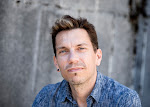

 Posts
Posts

