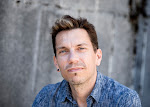
Yesterday I actually completed two interviews for the dance histories project. My second was with David McIntosh, co-artistic director (with Lee Su-Feh) of battery opera performance. It was a bit different from pervious interviews (both group and solo) for a couple of reasons. First, it took place on the deck of David's condo on Quebec Street, near Science World, and due to the way the seating was arranged I couldn't easily position the computer video to capture both David and I in the frame. Second, David is such a natural raconteur that it seemed egregious to interrupt him with our usual who/what/where/when questions. Essentially, I just let David talk.
And here, in no particular order, is what I learned:
- That David, though his parents were from Vancouver, was born in Kentucky.
- That, skipping high school one day, David wandered into the original VideoIn space on Powell Street and discovered Paul Wong flipping switches at an editing console and drinking green Chartreuse. David thought that he might like to do something like that one day.
- That David got kicked out of art school at Emily Carr for assaulting one of his teachers.
- That David is interested in what he calls the "gift of physicality" and what that allows a performer to get away with in the performer-spectator contract.
- That, having made a glitch-filled video about his days as a cab driver in Vancouver, David went to Hollywood to peddle it because he was told he looked like Steve McQueen and he was bound to find work there. Someone from MGM called him back saying he couldn't understand what the heck was going on in the video.
- That the work of battery opera, whether made by David or Su-Feh or together, is rooted in a common physical aesthetic that is derived in part from martial arts as a form.
- That for David technique is not the same thing as resonance.
- That David is not interested in working within the system to support the system.
- That David is deeply invested in Vancouver, not least in terms of its history as a (relatively recent) colonized space, and that no matter what (and whether he likes it or not) this place will always be his content.
Interview over, David then turned his camera on me and had me read (or, in truth, repeat after him) some lines from one of Clarice Lispector's novels. It seemed a fitting way to end the evening.
P
Showing posts with label battery opera. Show all posts
Showing posts with label battery opera. Show all posts
Tuesday, August 30, 2016

Friday, April 8, 2016
Vancouver Dance History (2006-2010): Post 11
Yesterday battery opera's Lee Su-Feh stopped by the sixth floor offices of The Dance Centre to chat with Justine, Alexa and I. She talked about coming to Vancouver in 1988 as a landed immigrant and that one of the first shows she saw was a piece by Peter Bingham featuring Noam Gagnon and Dana Gingras. That combination alone seems kinaesthetically perplexing, although I do know that Noam and Dana first met taking class with Peter at EDAM. However, what Su-Feh remembers most about the show was that while thematically it was supposed to be about conflict, she registered the exact opposite from the dancers' bodies. As she put it, she left the show thinking, "Wow, people are really happy here!"
Before forming battery opera with David McIntosh in 1995, Su-Feh created her own work (including her first piece in Vancouver, Tiger), and it was while presenting a couple of her solos at Dancing on the Edge that she met Anne Troake, who asked her to join D.U.C.K., or Daring Unknown Choreographers Kollective. Su-Feh then recounted the story behind a piece in which DUCK stopped folks on the street and asked them what they'd like to see in a dance show; they put every suggestion into the show. But at the end of the piece there is a moment in which the women dancers insert clothes hangars underneath their tops, deftly removing them to reveal the word "Mine" written across their backs. On the first evening they performed the piece, December 5, 1989, the moment received huge laughs. But on the second evening, with the news of the massacre at École polytechnique fresh in everyone's minds, there was nothing but silence.
Su-Feh also talked about dancing for Pipo Damiano and Susan Elliott in their company Frozen Eye, which when Susan took over its sole direction morphed into Anatomica. She was also in a piece that Cornelius Fischer-Credo made for Dancecorps based on the story of Joan of Arc; Su-Feh wore a nun's habit and walked around the studio with a television monitor strapped to her belly--and from which glowed the saintly image of Jean Seberg. The nun's habit, together with the red dress at the heart of Su-Feh's three-part solo, The Character of Dubious Morality, definitely has to become part of our costume repertoire.
In talking about dance moments that have stood out for her, Su-Feh focused on Spektator (2003) as a highlight for battery opera. An intensely physical work built around different bloodsports, including cock fighting, the piece features some very complicated rule-based scores of combat. By the intermission the piece's first audiences were in a frenzy, placing bets on which dancer would win. At the end, with a winner declared and his foe "dead" beside him on the stage, the audience leapt to its feet in wild applause. It was the "woo-woo" moment that Su-Feh said she'd always wanted for battery opera--whose work up until that point had mostly met with polite confusion. However, the Spektator ensemble couldn't bask in the moment because they deliberately forsook a bow at the end of the show.
Incidentally, in what forms part of another eery accident of timing in Su-Feh's dance career, battery opera first presented a portion of Spektator outside The Dance Centre on 9/11.
Towards the end of the interview, in reflecting on why she has stayed in Vancouver, and on what the future of Vancouver dance holds, Su-Feh said that having come to the city for love, it is now the place to which she is most connected in the world. And that, she elaborated, is because of the relationships she has formed here, which precisely because they require constant work and collaboration become a form of choreography. As for the future, Su-Feh said she's less interested in dance per se, than in bodies. And precisely because of Vancouver's unsettled colonial history and its links to resource extraction, among other fraught practices of place, thinking choreographically about how bodies are connected to larger pressing planetary questions means that this city becomes an interesting lab and a potential microcosm for how to be globally, and how to move together locally.
P.
Before forming battery opera with David McIntosh in 1995, Su-Feh created her own work (including her first piece in Vancouver, Tiger), and it was while presenting a couple of her solos at Dancing on the Edge that she met Anne Troake, who asked her to join D.U.C.K., or Daring Unknown Choreographers Kollective. Su-Feh then recounted the story behind a piece in which DUCK stopped folks on the street and asked them what they'd like to see in a dance show; they put every suggestion into the show. But at the end of the piece there is a moment in which the women dancers insert clothes hangars underneath their tops, deftly removing them to reveal the word "Mine" written across their backs. On the first evening they performed the piece, December 5, 1989, the moment received huge laughs. But on the second evening, with the news of the massacre at École polytechnique fresh in everyone's minds, there was nothing but silence.
Su-Feh also talked about dancing for Pipo Damiano and Susan Elliott in their company Frozen Eye, which when Susan took over its sole direction morphed into Anatomica. She was also in a piece that Cornelius Fischer-Credo made for Dancecorps based on the story of Joan of Arc; Su-Feh wore a nun's habit and walked around the studio with a television monitor strapped to her belly--and from which glowed the saintly image of Jean Seberg. The nun's habit, together with the red dress at the heart of Su-Feh's three-part solo, The Character of Dubious Morality, definitely has to become part of our costume repertoire.
In talking about dance moments that have stood out for her, Su-Feh focused on Spektator (2003) as a highlight for battery opera. An intensely physical work built around different bloodsports, including cock fighting, the piece features some very complicated rule-based scores of combat. By the intermission the piece's first audiences were in a frenzy, placing bets on which dancer would win. At the end, with a winner declared and his foe "dead" beside him on the stage, the audience leapt to its feet in wild applause. It was the "woo-woo" moment that Su-Feh said she'd always wanted for battery opera--whose work up until that point had mostly met with polite confusion. However, the Spektator ensemble couldn't bask in the moment because they deliberately forsook a bow at the end of the show.
Incidentally, in what forms part of another eery accident of timing in Su-Feh's dance career, battery opera first presented a portion of Spektator outside The Dance Centre on 9/11.
Towards the end of the interview, in reflecting on why she has stayed in Vancouver, and on what the future of Vancouver dance holds, Su-Feh said that having come to the city for love, it is now the place to which she is most connected in the world. And that, she elaborated, is because of the relationships she has formed here, which precisely because they require constant work and collaboration become a form of choreography. As for the future, Su-Feh said she's less interested in dance per se, than in bodies. And precisely because of Vancouver's unsettled colonial history and its links to resource extraction, among other fraught practices of place, thinking choreographically about how bodies are connected to larger pressing planetary questions means that this city becomes an interesting lab and a potential microcosm for how to be globally, and how to move together locally.
P.
Thursday, July 10, 2014
Veritas.trUth and Dance Machine at DOTE
Earlier this afternoon I took in two site-based works as part of the Dancing on the Edge Festival.
The first was Karissa Barry's Veritas.trUth, staged in the SFU Woodward's Cordova Street atrium and made in collaboration with students from the Modus Operandi Training Program. Six dancers, five women and one man, begin in the fetal position on the concrete plinths built into the brick risers leading towards the entrance to the Woodward's building. They are all clad in black and each sports a slash of orange paint down the length of their right arms. As a mix of house music (initially sounding quite Asian-themed) pours from two adjacent speakers, the dancers slowly unfurl their bodies, raising those orange arms skyward and gradually rising to a standing position. Weaving in and out of patrons sitting along the risers, the dancers eventually make their way to the accessible ramp running the length of the building, bopping up and down in a row behind it, almost as if they were in a studio inside practicing at the barre. Mixing hip-hop moves with parkour-inflected athleticism, Barry's choreography makes clever use of the built environment, with all the dancers eventually ending up on a single plinth, looking out into the courtyard and raising those orange arms in what one only imagines is a kind of group salute.
Then it was onto my bike for a quick ride through Strathcona and a final destination of battery opera's Hopbopshop at the foot of McLean Drive at Powell Street. There Lee Su-Feh, in collaboration with architect Jesse Garlick and dance artist Justine Chambers, has installed what she is calling the "beta version" of Dance Machine, a choreographic "environment" consisting of a series of bamboo poles attached to pulleys threaded through a central steel mechanism affixed to the ceiling; below the bamboo, on the floor, is a carpet of cedar boughs. Beginning yesterday and continuing through to the end of the DOTE Festival this Saturday, Lee and and her collaborators have invited several guest artists from the Vancouver dance community to interact with the machine. When I arrived today, the 605 Collective's Josh Martin was wrestling with the poles like a latter-day Samson (minus the hair): gathering them all up into his massive arms like spaghetti about to be thrown in a pot; carefully spreading them out from his back like wings; and bringing them horizontal so that he might wrap his legs around them, like the survivor of a shipwreck clinging to a makeshift raft. The smell of the cedar boughs as Martin trod upon them and ground them into his body while he was on the floor provided an added sensory element to the proceedings, as did the sound of the clinking bamboo, an extra bit of timpani to accompany the background music that was playing.

Chambers (who, incidentally, has an immersive work of her own--Family Dinner--at this year's DOTE Festival) said to me as I was leaving that each of the guest artists has been given some basic principles to work with in relation to the machine; apart from that, they are free to move and interact with it as they see fit. That the room--and consequently those of us inside it as spectators--is also made to move as a result is part of the quintessentially heterodox "dance-making" we have come to expect from Lee and her battery opera collaborators.
I bet, however, it's a pain to disentangle all that bamboo.
P.
The first was Karissa Barry's Veritas.trUth, staged in the SFU Woodward's Cordova Street atrium and made in collaboration with students from the Modus Operandi Training Program. Six dancers, five women and one man, begin in the fetal position on the concrete plinths built into the brick risers leading towards the entrance to the Woodward's building. They are all clad in black and each sports a slash of orange paint down the length of their right arms. As a mix of house music (initially sounding quite Asian-themed) pours from two adjacent speakers, the dancers slowly unfurl their bodies, raising those orange arms skyward and gradually rising to a standing position. Weaving in and out of patrons sitting along the risers, the dancers eventually make their way to the accessible ramp running the length of the building, bopping up and down in a row behind it, almost as if they were in a studio inside practicing at the barre. Mixing hip-hop moves with parkour-inflected athleticism, Barry's choreography makes clever use of the built environment, with all the dancers eventually ending up on a single plinth, looking out into the courtyard and raising those orange arms in what one only imagines is a kind of group salute.
Then it was onto my bike for a quick ride through Strathcona and a final destination of battery opera's Hopbopshop at the foot of McLean Drive at Powell Street. There Lee Su-Feh, in collaboration with architect Jesse Garlick and dance artist Justine Chambers, has installed what she is calling the "beta version" of Dance Machine, a choreographic "environment" consisting of a series of bamboo poles attached to pulleys threaded through a central steel mechanism affixed to the ceiling; below the bamboo, on the floor, is a carpet of cedar boughs. Beginning yesterday and continuing through to the end of the DOTE Festival this Saturday, Lee and and her collaborators have invited several guest artists from the Vancouver dance community to interact with the machine. When I arrived today, the 605 Collective's Josh Martin was wrestling with the poles like a latter-day Samson (minus the hair): gathering them all up into his massive arms like spaghetti about to be thrown in a pot; carefully spreading them out from his back like wings; and bringing them horizontal so that he might wrap his legs around them, like the survivor of a shipwreck clinging to a makeshift raft. The smell of the cedar boughs as Martin trod upon them and ground them into his body while he was on the floor provided an added sensory element to the proceedings, as did the sound of the clinking bamboo, an extra bit of timpani to accompany the background music that was playing.
Josh Martin wrestling with the Dance Machine, The Hopbopshop, July 10, 2014
Chambers (who, incidentally, has an immersive work of her own--Family Dinner--at this year's DOTE Festival) said to me as I was leaving that each of the guest artists has been given some basic principles to work with in relation to the machine; apart from that, they are free to move and interact with it as they see fit. That the room--and consequently those of us inside it as spectators--is also made to move as a result is part of the quintessentially heterodox "dance-making" we have come to expect from Lee and her battery opera collaborators.
I bet, however, it's a pain to disentangle all that bamboo.
P.
Thursday, December 5, 2013
Jacques and James at the Firehall
Local dance artist James Gnam, Co-Artistic Director of the plastic orchid factory, and Montreal-based Jacques Poulin-Denis, of Grand Poney, star in two paired talking dance solos at the Firehall Arts Centre through this Saturday evening.
Gnam and Poulin-Denis have been collaborating for the past couple of years on a new work called The Value of Things--which, according to Deborah Meyers in the Vancouver Sun yesterday, will premiere in Montreal in January. However, they've briefly taken some time away from that project to revisit in this program two earlier works from their solo repertoires.
In James, last seen at the 2011 Dance in Vancouver Biennial, Gnam uses his personal (and working) relationship with The Nutcracker (which he has danced more than 300 times) as the starting point to explore the institutional ideology of classical ballet training more generally. Working with battery opera's Lee Su-Feh, and combining spoken text and movement, Gnam weaves an autobiographical tale that moves from memories of his first 10-year-old walk-on part as one of dozens of skipping children from the National Ballet of Canada School to behind-the-scenes anecdotes about adult roles as a fill-in Cavalier in a 2008 semi-professional production in North Vancouver and his first time playing the Prince as a member of Les Grands Ballets Canadiens. Particularly in these last two sequences Gnam and Lee strip away the romanticism of ballet--and the sugar-coated fantasy of The Nutcracker, especially--revealing the economic and bodily labour, or work-time, that goes into the "timeless" execution of these familiar, and apparently effortless, steps.
For example, we learn that Gnam took the North Vancouver job following the collapse into financial insolvency of Ballet BC, of which he was then a member. Needing a job, he took the part of the Cavalier, whose main task is to accompany the Sugar Plum Fairy in the penultimate sequence of Act 2, a classically gendered scene of ballet partnering that is here recreated by having Gnam reproduce, to the strains of Tchaikovsky's music, various poses of male structural support, holding his invisible teenage partner's waist as he first moves her into a penchée and then dips her into an arabesque. However, in the studio there wasn't time to rehearse the Cavalier's solo variation that is meant to follow this pas de deux, and so as Gnam explains, when the music for said variation came on in performance he simply remained immobile, as he had nothing prepared to display.
Similarly, Gnam's debut as the Nutcracker Prince was a far less starry-eyed experience than one might at first expect. Suffering from food poisoning, weak with fatigue, and having dragged himself to class for the first time in more than a week, a still shaky Gnam is informed by the rehearsal director at the barre that he'll be going on as the Prince that night because the company member with whom he was sharing the part had broken his foot. This scene--and the piece as a whole--ends with Gnam repeating the sequence where the toy Prince, having magically come to life before Clara, steps from fifth position into a plié, before executing an explosive tour en l'air that is mean to end with the dancer landing on one knee, extending the other leg forward as he bows deeply before Clara. In that original Montreal performance, Gnam tells us, with his recent illness still lingering in his body, he had to extend a hand to the floor on the landing. But here, as he then goes on to show us, the wobble is allowed to become, in this retrospective excavation of dance memory, a signature part of the movement, with Gnam repeating it over and over again until he gets a smile from the statuary Drosselmeyer perched atop the Stahlbaums' clock.
In this moving and conceptually rich talking solo, Gnam and Lee have created a work that stands alongside the talking dance portraits of Jérôme Bel (particularly Véronique Doisneau and Cédric Andrieux), in which speech is used to ex-pose (in the double sense of presenting through exposition and decentering through arrested, suspended, and fragmented movement) the conceit of technical virtuosity, revealing in turn (quite literally in this case) the material conditions which always circumscribe moving bodies on stage. (The overlaps with Bel were confirmed in conversation with Natalie Lefebvre Gnam in the Firehall lobby, whose own material labour as a dance artist hovers over this presentation of James, her husband informing us at the start of his solo that but for an injury to Natalie's knee that he was accidentally responsible for, she would have been dancing on the program alongside him.) And, on that note, I'll just end by mentioning that it is a deconstructed port-de-bras phrase that serves as the choreographic refrain of the piece, one that links the various classic scenes from The Nutcracker that Gnam recreates for us. Perhaps the simplest move in ballet from an audience perspective, it is actually one over which the dancer labours intensely in order to make it seem effortlessly graceful.
Poulin-Denis' Cible de Dieu begins similarly to James, with the dancer striding boldly on stage and addressing the audience directly. We learn that the piece we are about to see is as a result of Poulin-Denis' recent training in circus techniques, particularly balancing acts. However, we are also told that the chair on stage is not the one Poulin-Denis normally works with, and so tonight things might not necessarily go according to plan. Couple that with the fact that Gnam, up in the tech booth, can't seem to get the music to work and, well, things are off to a very rocky start indeed. But the charismatic Poulin-Denis is undaunted and after getting the audience to hum along to the familiar strains of Beethoven's Für Elise, he begins to dance with the chair.
Needless to say, given my fascination with chairs as both aesthetic objects and supports/props for movement (not to mention the fact that Poulin-Denis' chosen chair was a Thonet bentwood knock-off), I was primed with expectation. However, the various feats of balance and physical dexterity that Poulin-Denis goes on to perform notwithstanding, the point here is that this particular substitute chair is not an aid to the dancer's movement, but rather an impediment, and even as we continue to hum the notes to Für Elise as encouragement, Poulin-Denis eventually breaks off in frustration. Later he is similarly thrown off by the presence of someone from his past who is apparently in the audience. And on it goes, with Poulin-Denis moving back and forth from issuing abject apologies to the audience for all that is going wrong to stunning feats of choreography in spite of this.
All of which, it gradually becomes clear, is Poulin-Denis' way of addressing by not addressing what should logically be the most insurmountable obstacle to his performance: his prosthetic leg. Indeed, it was only midway through his first sustained sequence with the chair that I even noticed that below his right knee Poulin-Denis wears an artificial limb. And it is only when, a bit later on, it comes off that we realize how conceptually central and practically insignificant the prosthesis is to the dance in this piece. By that I mean that the balancing act Poulin-Denis subsequently performs on one leg--no less virtuosic because, all of a sudden, more visually unassimilable--is meant to challenge our expectations not just of the body who is dancing, but also how that body is dancing.
Sounds an awful lot like the ideological apparatus of ballet itself.
P.
Gnam and Poulin-Denis have been collaborating for the past couple of years on a new work called The Value of Things--which, according to Deborah Meyers in the Vancouver Sun yesterday, will premiere in Montreal in January. However, they've briefly taken some time away from that project to revisit in this program two earlier works from their solo repertoires.
In James, last seen at the 2011 Dance in Vancouver Biennial, Gnam uses his personal (and working) relationship with The Nutcracker (which he has danced more than 300 times) as the starting point to explore the institutional ideology of classical ballet training more generally. Working with battery opera's Lee Su-Feh, and combining spoken text and movement, Gnam weaves an autobiographical tale that moves from memories of his first 10-year-old walk-on part as one of dozens of skipping children from the National Ballet of Canada School to behind-the-scenes anecdotes about adult roles as a fill-in Cavalier in a 2008 semi-professional production in North Vancouver and his first time playing the Prince as a member of Les Grands Ballets Canadiens. Particularly in these last two sequences Gnam and Lee strip away the romanticism of ballet--and the sugar-coated fantasy of The Nutcracker, especially--revealing the economic and bodily labour, or work-time, that goes into the "timeless" execution of these familiar, and apparently effortless, steps.
For example, we learn that Gnam took the North Vancouver job following the collapse into financial insolvency of Ballet BC, of which he was then a member. Needing a job, he took the part of the Cavalier, whose main task is to accompany the Sugar Plum Fairy in the penultimate sequence of Act 2, a classically gendered scene of ballet partnering that is here recreated by having Gnam reproduce, to the strains of Tchaikovsky's music, various poses of male structural support, holding his invisible teenage partner's waist as he first moves her into a penchée and then dips her into an arabesque. However, in the studio there wasn't time to rehearse the Cavalier's solo variation that is meant to follow this pas de deux, and so as Gnam explains, when the music for said variation came on in performance he simply remained immobile, as he had nothing prepared to display.
Similarly, Gnam's debut as the Nutcracker Prince was a far less starry-eyed experience than one might at first expect. Suffering from food poisoning, weak with fatigue, and having dragged himself to class for the first time in more than a week, a still shaky Gnam is informed by the rehearsal director at the barre that he'll be going on as the Prince that night because the company member with whom he was sharing the part had broken his foot. This scene--and the piece as a whole--ends with Gnam repeating the sequence where the toy Prince, having magically come to life before Clara, steps from fifth position into a plié, before executing an explosive tour en l'air that is mean to end with the dancer landing on one knee, extending the other leg forward as he bows deeply before Clara. In that original Montreal performance, Gnam tells us, with his recent illness still lingering in his body, he had to extend a hand to the floor on the landing. But here, as he then goes on to show us, the wobble is allowed to become, in this retrospective excavation of dance memory, a signature part of the movement, with Gnam repeating it over and over again until he gets a smile from the statuary Drosselmeyer perched atop the Stahlbaums' clock.
In this moving and conceptually rich talking solo, Gnam and Lee have created a work that stands alongside the talking dance portraits of Jérôme Bel (particularly Véronique Doisneau and Cédric Andrieux), in which speech is used to ex-pose (in the double sense of presenting through exposition and decentering through arrested, suspended, and fragmented movement) the conceit of technical virtuosity, revealing in turn (quite literally in this case) the material conditions which always circumscribe moving bodies on stage. (The overlaps with Bel were confirmed in conversation with Natalie Lefebvre Gnam in the Firehall lobby, whose own material labour as a dance artist hovers over this presentation of James, her husband informing us at the start of his solo that but for an injury to Natalie's knee that he was accidentally responsible for, she would have been dancing on the program alongside him.) And, on that note, I'll just end by mentioning that it is a deconstructed port-de-bras phrase that serves as the choreographic refrain of the piece, one that links the various classic scenes from The Nutcracker that Gnam recreates for us. Perhaps the simplest move in ballet from an audience perspective, it is actually one over which the dancer labours intensely in order to make it seem effortlessly graceful.
Poulin-Denis' Cible de Dieu begins similarly to James, with the dancer striding boldly on stage and addressing the audience directly. We learn that the piece we are about to see is as a result of Poulin-Denis' recent training in circus techniques, particularly balancing acts. However, we are also told that the chair on stage is not the one Poulin-Denis normally works with, and so tonight things might not necessarily go according to plan. Couple that with the fact that Gnam, up in the tech booth, can't seem to get the music to work and, well, things are off to a very rocky start indeed. But the charismatic Poulin-Denis is undaunted and after getting the audience to hum along to the familiar strains of Beethoven's Für Elise, he begins to dance with the chair.
Needless to say, given my fascination with chairs as both aesthetic objects and supports/props for movement (not to mention the fact that Poulin-Denis' chosen chair was a Thonet bentwood knock-off), I was primed with expectation. However, the various feats of balance and physical dexterity that Poulin-Denis goes on to perform notwithstanding, the point here is that this particular substitute chair is not an aid to the dancer's movement, but rather an impediment, and even as we continue to hum the notes to Für Elise as encouragement, Poulin-Denis eventually breaks off in frustration. Later he is similarly thrown off by the presence of someone from his past who is apparently in the audience. And on it goes, with Poulin-Denis moving back and forth from issuing abject apologies to the audience for all that is going wrong to stunning feats of choreography in spite of this.
All of which, it gradually becomes clear, is Poulin-Denis' way of addressing by not addressing what should logically be the most insurmountable obstacle to his performance: his prosthetic leg. Indeed, it was only midway through his first sustained sequence with the chair that I even noticed that below his right knee Poulin-Denis wears an artificial limb. And it is only when, a bit later on, it comes off that we realize how conceptually central and practically insignificant the prosthesis is to the dance in this piece. By that I mean that the balancing act Poulin-Denis subsequently performs on one leg--no less virtuosic because, all of a sudden, more visually unassimilable--is meant to challenge our expectations not just of the body who is dancing, but also how that body is dancing.
Sounds an awful lot like the ideological apparatus of ballet itself.
P.
Friday, November 22, 2013
Dance in Vancouver Programs 3 and 4
The 9th Biennial Dance in Vancouver Festival is on at the Dance Centre through this Saturday. Curated this year by the Toronto-based Jeanne Holmes, Artistic Producer of the Canada Dance Festival, DIV 2013's mainstage shows highlight the depth, range, and diversity of contemporary movement expression in this city. Lucky enough to have been asked by Associate Producer Claire French to lead talkbacks after the 9 pm shows last night and on Saturday, I decided to take in the 7 pm presentations as well, thereby getting a chance to see and comment on the full line-up.
First up last night was Ziyian Kwan/dumb instrument Dance's the neck to fall. A virtuosic interpreter of others' work in Vancouver for several decades, the neck is actually Kwan's choreographic debut. It's a piece that announces a major new compositional voice in the city. Inspired by the words of the Canadian modern dancer and somatic instructor Amelia Itcush (who pioneered the teaching of Alexander, Mitzvah and her own Itcush techniques in this country), Kwan's solo combines explosive movement and plosive speech to explore, among other things, the body's relationship to external objects and external commands. One of the most memorable sequences for me was when, near the end of the piece, Kwan lifts up a large cardboard box positioned upstage left to reveal a wooly stool underneath. Eventually turning the stool on its side, Kwan rolls her body with and over it in a series of lyrically graceful waves that make both body and stool extensionally (and elastically) equivalent.
The second work on the 7 pm program was DVOTE, a choreographic and performance collaboration between Vision Impure's Noam Gagnon and Nova Dance's Nova Bhattacharya, a classically trained Bharatanatyam dancer who brings that training to her work in contemporary dance. The work opens with the two dancers, clad all in black and with their faces obscured by masks, in a limb-to-limb tussle/clinch on the upstage right edge of a black square that has been taped down in the middle of the stage. Pulling themselves apart, each proceeds to move in the opposite direction around the perimeter of the square. During this sequence Bhattacharya is mostly vertical, whereas Gagnon's body is more horizontal and oriented to the floor, a visual contrast that establishes not just the different dance idioms being combined in the piece, but also perhaps differences in gender and bodily energies. Eventually, however, those bodies collide, and into the maw of the black square they inevitably tumble. It is not entirely clear to me if this recombining is meant to be harmonious or violent; nor am I sure what to make of the ending of last night's excerpt, which sees the two dancers edge very close to the first row of the audience before the final blackout.
After a 45-minute intermission (long enough to grab a quick glass of wine and a bit of conversation at the pop-up bar DIV 2013 has established at the Vancouver International Film Centre around the corner on Seymour Street), it was time for Program Four. I've written about the plastic orchid factory's _post twice before: here and here. What was interesting this third time was to see how the excerpt from the piece that choreographer James Gnam had chosen to present had been reconfigured for a proscenium stage. Originally, the work had been presented (also at the Dance Centre) in the round, with the audience encircling the dancers, and in the talkback afterwards Gnam commented on the challenge of reconceiving the effects of intimacy and proximity he and his fellow performer-collaborators were striving to achieve in the piece. Nevertheless the conceptual bones (as in the material imprinting of the history of classical ballet upon the body) and the theatrical effects (all of that tulle!) remain as strong as ever.
The evening ended with battery opera's Lee Su-Feh performing her solo Everything. Set to Barry Truax's I Ching-inspired electroacoustic score, the work makes use of Daoist ritual objects--a clutch of ruby red joss sticks, incense, spirit paper--to explore the bodily labour involved in negotiating the chance intersections of history, space and place. By that I mean that, as Lee outlined much more eloquently in our talkback, the work is in part an investigation of what it means for her as an ethnic Chinese immigrant from Malaysia to bring the cultural histories embedded in her body to bear (quite literally) on work she creates in a region where traditional Indigenous territories have been overlain with the history of settler colonialism.
As last night's program attests, Vancouver dance is not just physically experimental, but also intellectually rigorous. I look forward to Saturday.
P.
First up last night was Ziyian Kwan/dumb instrument Dance's the neck to fall. A virtuosic interpreter of others' work in Vancouver for several decades, the neck is actually Kwan's choreographic debut. It's a piece that announces a major new compositional voice in the city. Inspired by the words of the Canadian modern dancer and somatic instructor Amelia Itcush (who pioneered the teaching of Alexander, Mitzvah and her own Itcush techniques in this country), Kwan's solo combines explosive movement and plosive speech to explore, among other things, the body's relationship to external objects and external commands. One of the most memorable sequences for me was when, near the end of the piece, Kwan lifts up a large cardboard box positioned upstage left to reveal a wooly stool underneath. Eventually turning the stool on its side, Kwan rolls her body with and over it in a series of lyrically graceful waves that make both body and stool extensionally (and elastically) equivalent.
The second work on the 7 pm program was DVOTE, a choreographic and performance collaboration between Vision Impure's Noam Gagnon and Nova Dance's Nova Bhattacharya, a classically trained Bharatanatyam dancer who brings that training to her work in contemporary dance. The work opens with the two dancers, clad all in black and with their faces obscured by masks, in a limb-to-limb tussle/clinch on the upstage right edge of a black square that has been taped down in the middle of the stage. Pulling themselves apart, each proceeds to move in the opposite direction around the perimeter of the square. During this sequence Bhattacharya is mostly vertical, whereas Gagnon's body is more horizontal and oriented to the floor, a visual contrast that establishes not just the different dance idioms being combined in the piece, but also perhaps differences in gender and bodily energies. Eventually, however, those bodies collide, and into the maw of the black square they inevitably tumble. It is not entirely clear to me if this recombining is meant to be harmonious or violent; nor am I sure what to make of the ending of last night's excerpt, which sees the two dancers edge very close to the first row of the audience before the final blackout.
After a 45-minute intermission (long enough to grab a quick glass of wine and a bit of conversation at the pop-up bar DIV 2013 has established at the Vancouver International Film Centre around the corner on Seymour Street), it was time for Program Four. I've written about the plastic orchid factory's _post twice before: here and here. What was interesting this third time was to see how the excerpt from the piece that choreographer James Gnam had chosen to present had been reconfigured for a proscenium stage. Originally, the work had been presented (also at the Dance Centre) in the round, with the audience encircling the dancers, and in the talkback afterwards Gnam commented on the challenge of reconceiving the effects of intimacy and proximity he and his fellow performer-collaborators were striving to achieve in the piece. Nevertheless the conceptual bones (as in the material imprinting of the history of classical ballet upon the body) and the theatrical effects (all of that tulle!) remain as strong as ever.
The evening ended with battery opera's Lee Su-Feh performing her solo Everything. Set to Barry Truax's I Ching-inspired electroacoustic score, the work makes use of Daoist ritual objects--a clutch of ruby red joss sticks, incense, spirit paper--to explore the bodily labour involved in negotiating the chance intersections of history, space and place. By that I mean that, as Lee outlined much more eloquently in our talkback, the work is in part an investigation of what it means for her as an ethnic Chinese immigrant from Malaysia to bring the cultural histories embedded in her body to bear (quite literally) on work she creates in a region where traditional Indigenous territories have been overlain with the history of settler colonialism.
As last night's program attests, Vancouver dance is not just physically experimental, but also intellectually rigorous. I look forward to Saturday.
P.
Monday, February 18, 2013
Widening Gyres and Full Body Scans
In the famous opening stanza to W.B. Yeats' "The Second Coming," we are told:
Turning and turning in the widening gyre
The falcon cannot hear the falconer;
Things fall apart; the centre cannot hold;
Mere anarchy is loosed upon the world,
The blood-dimmed tide is loosed, and everywhere
The ceremony of innocence is drowned;
The best lack all conviction, while the worst
Are full of passionate intensity.
I've found myself returning to these lines over the past few days as I've struggled to articulate here on this blog (not usually a problem for me) my response to Body-Scan: Sweet Gyre, a piece created by Lee Su-Feh (of battery opera) and Benoît Lachambre (of Par B.Leux), and performed last week as part of The Dance Centre's Global Dance Connections series. A work that, in the words of its choreographers, "recyles, re-uses, and re-imagines" elements from an earlier 2008 collaboration for six dancers, here Lee and and Lachambre--together with Jesse Zubot, who provides live musical accompaniment--loose the full panoply of their anarchic creative energies upon the audience. And if, like me, one cannot find a stable formal or thematic centre upon which to pitch one's interpretation of the piece, that doesn't mean one won't continue to turn and turn around in one's head its spiraling layers.
For me those layers are composed of contrasting movements and sounds and scales and textures and colours:
- Lee's slow, durational, pause-punctuated immersion of her body into the pile of sleeping bags downstage vs. Lachambre's jerky skittering of his chair horizontally upstage left to right
- or, later, Lee, now on the chair dressed in a sleeping bag skirt and vest, slowing wending her way to the microphone near Zubot in order to coo into it like a bird vs. Lachambre's manic flitting about the stage saying "I love you," the sound of aluminum clothes pins jangling in the pockets of his hoodie
- the double-sided sleeping bags themselves: vibrantly coloured on the outside when scattered on the floor, or strung together along a rope upstage; but turned inside out and affixed to a succession of step ladders of different heights, they reveal monochromatic portraits of the dancers in the original 2008 piece
- and, finally, the piece's closing tableau: blue tarpaulin pulled above the audience to fashion a synthetic sky, while below us, on stage, artificial turf is rolled out, upon which Lee and Lachambre, in custom-made outfits of oiled laytex, slowly turn and turn and turn
I couldn't always make sense of what was going on before me, but I always had some sort of sensory reaction to what I was witnessing. I was never less than fully engaged. Which is, after all, what one desires from live performance. As my friend and colleague, DD Kugler, said to me afterwards, we all owe a debt to artists like Lee and Lachambre, who in pushing the limits of what dance and performance is and can be, allow the rest of us to have room to experiment and play in our own very modest ways.
There is no lacking of conviction or passion in these two performers, and if drowning in the alchemical results causes our own aesthetic expectations to fall apart, we are the better for it.
P.
Turning and turning in the widening gyre
The falcon cannot hear the falconer;
Things fall apart; the centre cannot hold;
Mere anarchy is loosed upon the world,
The blood-dimmed tide is loosed, and everywhere
The ceremony of innocence is drowned;
The best lack all conviction, while the worst
Are full of passionate intensity.
I've found myself returning to these lines over the past few days as I've struggled to articulate here on this blog (not usually a problem for me) my response to Body-Scan: Sweet Gyre, a piece created by Lee Su-Feh (of battery opera) and Benoît Lachambre (of Par B.Leux), and performed last week as part of The Dance Centre's Global Dance Connections series. A work that, in the words of its choreographers, "recyles, re-uses, and re-imagines" elements from an earlier 2008 collaboration for six dancers, here Lee and and Lachambre--together with Jesse Zubot, who provides live musical accompaniment--loose the full panoply of their anarchic creative energies upon the audience. And if, like me, one cannot find a stable formal or thematic centre upon which to pitch one's interpretation of the piece, that doesn't mean one won't continue to turn and turn around in one's head its spiraling layers.
For me those layers are composed of contrasting movements and sounds and scales and textures and colours:
- Lee's slow, durational, pause-punctuated immersion of her body into the pile of sleeping bags downstage vs. Lachambre's jerky skittering of his chair horizontally upstage left to right
- or, later, Lee, now on the chair dressed in a sleeping bag skirt and vest, slowing wending her way to the microphone near Zubot in order to coo into it like a bird vs. Lachambre's manic flitting about the stage saying "I love you," the sound of aluminum clothes pins jangling in the pockets of his hoodie
- the double-sided sleeping bags themselves: vibrantly coloured on the outside when scattered on the floor, or strung together along a rope upstage; but turned inside out and affixed to a succession of step ladders of different heights, they reveal monochromatic portraits of the dancers in the original 2008 piece
- and, finally, the piece's closing tableau: blue tarpaulin pulled above the audience to fashion a synthetic sky, while below us, on stage, artificial turf is rolled out, upon which Lee and Lachambre, in custom-made outfits of oiled laytex, slowly turn and turn and turn
I couldn't always make sense of what was going on before me, but I always had some sort of sensory reaction to what I was witnessing. I was never less than fully engaged. Which is, after all, what one desires from live performance. As my friend and colleague, DD Kugler, said to me afterwards, we all owe a debt to artists like Lee and Lachambre, who in pushing the limits of what dance and performance is and can be, allow the rest of us to have room to experiment and play in our own very modest ways.
There is no lacking of conviction or passion in these two performers, and if drowning in the alchemical results causes our own aesthetic expectations to fall apart, we are the better for it.
P.
Thursday, March 3, 2011
Life Lived as a Sentence
Random thoughts on Life Sentences, Peter Bingham's mixed program for EDAM last night at the Roundhouse, on through this evening as part of this year's Vancouver International Dance Festival:
1. Sentences on life: I was pleasantly surprised by the recorded text (along with video, and of course EDAM's always amazing music/soundscapes and lighting design--yay James P.!) that preceded several of the pieces. Though not always the case, I generally see Bingham's work--and contact improvisation more generally--as eschewing any overtly narrative or storying impulse. And, indeed, last night the connections between the choreography and the spoken text were by no means explicitly evoked. Still, for each piece we were given some sort of external frame through which to view the dancing (starting with Chris Randle's photo retrospective outside the performance space, which captures many shots of EDAM dancers, both older and newer).
2. Sentencing life: Captivity and time were major themes subtending the entire program (foregrounded especially by James Proudfoot's tight spots in the third and fourth pieces), and as the aesthetics of dance are all about repetition, the work of moving bodies over time, it is hard not to read much of this material as a reflexive (and retrospective?) commentary on a life of/in dance. It was all very Proustian.
3. Live bodies as sentences: For me, the thrill of Bingham's contact improv has always been watching the dancers fling their bodies at and toward each other with such abandon, only to land upon and/or receive each other's weight with such lightness and delicacy and grace. If I can employ a typographic metaphor, in Bingham's work bodies often start out in a given sequence as exclamation marks (and verticality is important here), only to finish as question marks, dipping toward the floor, or rolling over another's rounded back, asking "Where do we go from here"? This was most in evidence in the first and last pieces on the program, with James Gnam and Farley Johansson reinventing the laws of gravity in the duet Right in Front of You, and then being joined, at the end of the evening, by Alana Gerecke (yay Alana!) and Stacey Murchison for the closing quartet Release Me. Capture and release were certainly in evidence in many of the lifts and jumps on display here, and it always boggles my mind the degree of trust needed to accomplish some of Bingham's moves. Blind back flips by Alana into James' outstretched hands--that's a statement you don't want to have too much doubt about!
Life Sentences was preceded by a free show by battery opera, featuring Artistic Director Lee Su-Feh and Victoria-based dancer Chung Jung-Ah being each other's private dancer in public. What amazing movers they both are.
P.
Friday, February 4, 2011
Checking In
When you think of making an hour-long visit to a hotel room in your own city, likely the shortlist of scenarios of what's going to happen in that room is pretty small. In fact, David McIntosh's new site-specific dance-theatre piece for battery opera, M/HOTEL, on at the Holiday Inn on Howe Street through this Sunday, suggests a much broader spectrum of things to enjoy with strangers in said rooms than hospital corners on bedsheets and those tiny, pre-wrapped toiletries.
I don't want to give away what happens, but I suggest arriving early (rooms are available hourly beginning at 6 pm) and spending the night. Look for David in the Lobby Bar to collect your room key. Rates negotiable.
P.
Monday, January 31, 2011
PuSh Review #10: PodPlays-The Quartet
Yesterday the sky was cloudless, the air crisp, and my time mostly disposable. In other words, it was the perfect occasion for a brisk afternoon walk of the city--which is exactly what I did courtesy of the PuSh Festival's PodPlays, a quartet of outdoor audio dramas commissioned by Neworld Theatre and the Playwrights Theatre Centre that leads participants on a surprising and intimate guided tour of Vancouver's downtown core.
The tour begins in the Cordova Street atrium at SFU Woodward's, where efficient Neworld staff equip one with a portable media player, a set of headphones, and a map. Then all you do is hit the play button and await direction. A warm, pleasant female voice (that of Yumi Ogawa, our guide and host) instructs you to climb to the top of the spiral staircase adjacent the Nester's store (something I'd yet to do since the reopening of the Woodward's complex) and face the eastern brick wall. This is the departure point for the first play, Look Up, written by Neworld's Adrienne Wong, and performed by Wong and Todd Thomson. As you are guided through a pedestrian overpass, a carpark, and eventually east on Water and Alexander Streets, you learn of a couple's move to Vancouver and their evolving relationship with the city, and with each other.
At the old Alexander Street Pump Station you begin the second leg of your tour: Five Meditations on the Future City, written by Proximity Arts' Christine Stoddard and Tanya Marquart, and narrated by Karin Konoval, leads you to Main Street, over the bridge at the north end of it, and through CRAB Park. Looking at the train tracks below the bridge, or across Burrard Inlet to the North Shore mountains, or at the memorial marker in the park to the murdered and missing women of the Downtown Eastside, you are invited to contemplate all that a future-oriented urban temporality necessarily overwrites.
Through a parking lot for cruise ship passengers you arrive at Waterfront Road, and the start of the third play. Portside Walk is written and performed by battery opera's David McIntosh, and it takes you west, towards Canada Place and the new Vancouver Convention Centre. But at the same time as the text directs you to look at the flying buttresses of these monuments to the city's global cosmopolitan progress it also insistently digs deeper, to the buried roots and the much-trafficked routes of that progress, a scenario of transnational contact, conquest, and migration that we continue to replay to this day--not least in terms of those unseen underclasses who service our taken-for-granted urban mega-projects and amenities. To this end, it's a singular achievement of this third--and, I think, strongest--link in the quartet that we actually traverse the service road underneath the new convention centre. A carpark elevator eventually takes you to the more salubrious outdoor plaza of the centre, complete with the cauldron from the recent Olympic Winter Games.
Cross Cordova and Hastings, and then up Burrard: you're off on the final leg of the tour. G...Cordova, written by Martin Kinch, and performed by Patrick Keating and the wonderful Gina Stockdale (whose dulcet tones I absolutely loved having in my ear) concerns a son and his aging, Alzheimerish mother. In this piece, which eventually deposits you at the Vancouver Art Gallery, lapses in individual memory get inscribed onto the built environment, becoming a metaphor for a collective urban amnesia that of course haunts all four plays.
Cities are built spaces, to be sure, but they are first and foremost embodied spaces. As Michel de Certeau has famously argued, walking is "an elementary form" of experiencing the city, a tactical procedure which produces new maps that don't always correspond with the official criss-crossings of streets you find in guidebooks or A-Zs, maps which are anyway out of proportion in terms of scale, and which (as per the very alphabetical designation of A-Z) are all about shepherding folks (usually tourists) to a destination rather than exploring a location. De Certeau notes that we are not always able to read the maps we write with our bodies, but in the very fleeting moments of passing and being passed by we nevertheless open up cracks in the pavement, steal time, and breathe life into possible new intersections.
PodPlays will remind you of this, and so much more. It continues next Thursday, Friday, and Saturday, with departures leaving every 5 minutes between 12 and 4 pm.
P.
Thursday, February 12, 2009
$1 Billion
That’s the total estimated costs for Olympics-related security in 2010, as finally confirmed by the federal government today. Organizers had originally budgeted one-fifth that amount. I guess this helps pay for all the helicopters that have been buzzing overhead in Vancouver during the past week as part of various “training exercises.” Nothing like going into full lockdown mode so we can all safely watch men and women hurl themselves down mountains or slap a little black disc across the ice. And so what if that means residents and business owners in the line of fire, as it were, have to put their lives and jobs on hold for two weeks or more as perimeter fencing is erected around their homes and stores? It’s all in the spirit of fun and cross-cultural bonding.
It’s exactly one year from today that the whole spectacle begins, and as you can tell I’m starting to get worked up. There are all sorts of celebratory events taking place across the city today, including a torchlight ski extravaganza on Grouse Mountain. I recommend, instead, hauling ass to the counter-torchlight parade being organized by the Olympic Resistance Network at Victory Square at 6 pm: details at www.no2010.com. This follows upon the 2nd Annual Poverty Olympics, which took place in the DTES on Monday. And a talk by Helen Lenskyj, a noted critic of the Olympics industry, on Tuesday (thanks, Myka, for the notice); I quote Lenskyj in my book, but alas I couldn’t go to her talk as I was at another event (see below).
In related news, Gary Mason reveals in today’s Globe that the city seems to have worked out a financing deal with a consortium of Canadian banks that will allow them to borrow approximately $800 million at a reduced interest rate of only 3% in order to pay back Fortress Investment and see that the troubled Athletes Village gets finished on time. This is good news, and while taxpayers are by no means in the clear yet, the situation is looking a lot better than it was several weeks ago. Kudos to Mayor Gregor for his quiet but intense negotiating on this one.
And kudos to City Council for also voting to cancel a plan to extend additional funding to the Downtown Ambassadors Program (DAP). A human rights complaint against Genesis Security, the private firm that staffs the program, and the Downtown Business Improvement Association, which will continue to pay for it in its current jurisdictional mandate, has recently gone forward at the BC Human Rights Tribunal. It alleges that the DAP’s coordinated intimidation of the street homeless population in the Downtown Eastside essentially amounts to a violation of the right to public assembly, and that in targeting some of the most marginalized populations in the city (Aboriginal people, the homeless, the addicted, and the mentally ill) is fundamentally discriminatory. (Lenskyj has noted that our DAP is directly modeled on a similar “hospitality force” put in place in Atlanta in advance of the 1996 Summer Olympics.) My friend Jamie, who actually covertly trained with Genesis as part of an art project he is working on relating to the DAP, gave a deposition as part of the complaint, and is keeping me informed about its progress.
In the last post I reported on the rethink at City Hall about cultural programming and funding, and the possibility that we might get an independent Arts Council. Apparently opinion is divided on this issue, both among councillors and arts administrators: check out this item from The Georgia Straight. This is an issue I also will keep tracking. The same item in the GS also reports that attendance at this year’s PuSh Festival exceeded 24,000 and that Club PuSh, in particular, was a roaring success. Hurrah!
On Tuesday Alana and I went to see battery opera’s site-specific piece Lives Were Around Me. We were part of an intimate audience of three that assembled at the Alibi Room at 8 pm (we arrived earlier for a dinner, which was discounted by 10%, a nice surprise). After signing a liability waiver, we began following battery opera’s dapperly dressed David McIntosh east on Alexander Street. McIntosh was a charming, if cryptic, guide (“You can’t believe everything you hear” was the one line he kept repeating); he led us to the Firehall, on Cordova, where we were eventually met by Adrienne Wong (we would also later encounter Paul Ternes), who was more talkative, although no more understandable. This was because the text of the walking tour we were taking of the Downtown Eastside was freely adapted from James Kelman’s Translated Accounts, an abstruse, Kafkaesque novel made up of monologues detailing instances of surveillance, arrest, detention, and torture carried out in an unnamed police state. The effect was deliberately disorienting, forcing us to reexamine a part of the city that has historically been overdetermined with meaning, not to mention over-policed by various state apparatuses invested in the interpretation of that meaning. However, I think in the end the text dominated too much, and that the piece was perhaps overconceptualized dramaturgically, to the point where external intrusions—that is, the very space and community where the event was taking place—seemed to flummox our guide.
It’s exactly one year from today that the whole spectacle begins, and as you can tell I’m starting to get worked up. There are all sorts of celebratory events taking place across the city today, including a torchlight ski extravaganza on Grouse Mountain. I recommend, instead, hauling ass to the counter-torchlight parade being organized by the Olympic Resistance Network at Victory Square at 6 pm: details at www.no2010.com. This follows upon the 2nd Annual Poverty Olympics, which took place in the DTES on Monday. And a talk by Helen Lenskyj, a noted critic of the Olympics industry, on Tuesday (thanks, Myka, for the notice); I quote Lenskyj in my book, but alas I couldn’t go to her talk as I was at another event (see below).
In related news, Gary Mason reveals in today’s Globe that the city seems to have worked out a financing deal with a consortium of Canadian banks that will allow them to borrow approximately $800 million at a reduced interest rate of only 3% in order to pay back Fortress Investment and see that the troubled Athletes Village gets finished on time. This is good news, and while taxpayers are by no means in the clear yet, the situation is looking a lot better than it was several weeks ago. Kudos to Mayor Gregor for his quiet but intense negotiating on this one.
And kudos to City Council for also voting to cancel a plan to extend additional funding to the Downtown Ambassadors Program (DAP). A human rights complaint against Genesis Security, the private firm that staffs the program, and the Downtown Business Improvement Association, which will continue to pay for it in its current jurisdictional mandate, has recently gone forward at the BC Human Rights Tribunal. It alleges that the DAP’s coordinated intimidation of the street homeless population in the Downtown Eastside essentially amounts to a violation of the right to public assembly, and that in targeting some of the most marginalized populations in the city (Aboriginal people, the homeless, the addicted, and the mentally ill) is fundamentally discriminatory. (Lenskyj has noted that our DAP is directly modeled on a similar “hospitality force” put in place in Atlanta in advance of the 1996 Summer Olympics.) My friend Jamie, who actually covertly trained with Genesis as part of an art project he is working on relating to the DAP, gave a deposition as part of the complaint, and is keeping me informed about its progress.
In the last post I reported on the rethink at City Hall about cultural programming and funding, and the possibility that we might get an independent Arts Council. Apparently opinion is divided on this issue, both among councillors and arts administrators: check out this item from The Georgia Straight. This is an issue I also will keep tracking. The same item in the GS also reports that attendance at this year’s PuSh Festival exceeded 24,000 and that Club PuSh, in particular, was a roaring success. Hurrah!
On Tuesday Alana and I went to see battery opera’s site-specific piece Lives Were Around Me. We were part of an intimate audience of three that assembled at the Alibi Room at 8 pm (we arrived earlier for a dinner, which was discounted by 10%, a nice surprise). After signing a liability waiver, we began following battery opera’s dapperly dressed David McIntosh east on Alexander Street. McIntosh was a charming, if cryptic, guide (“You can’t believe everything you hear” was the one line he kept repeating); he led us to the Firehall, on Cordova, where we were eventually met by Adrienne Wong (we would also later encounter Paul Ternes), who was more talkative, although no more understandable. This was because the text of the walking tour we were taking of the Downtown Eastside was freely adapted from James Kelman’s Translated Accounts, an abstruse, Kafkaesque novel made up of monologues detailing instances of surveillance, arrest, detention, and torture carried out in an unnamed police state. The effect was deliberately disorienting, forcing us to reexamine a part of the city that has historically been overdetermined with meaning, not to mention over-policed by various state apparatuses invested in the interpretation of that meaning. However, I think in the end the text dominated too much, and that the piece was perhaps overconceptualized dramaturgically, to the point where external intrusions—that is, the very space and community where the event was taking place—seemed to flummox our guide.
This was most evident at the bar we entered midway through the piece. Like any bar in that part of town, it was filled with a larger-than-life cast of characters, and while a table had been reserved at the back for us (complete with a complimentary beer each) we were sharing the space with Bobby and his friend. We soon learned both just been released from jail and were interested in making conversation, and perhaps more (Bobby seemed to take a particular fancy to yours truly, displaying his tattoos, and offering up multiple hugs). But our guide, while polite with Bobby and tolerant of his interruptions to a point, kept telling him that she had to keep to her schedule, and consequently kept drawing us back to the tale she was telling. In other words, despite the piece being all about looking at/for/through evidence (we later had a tour of the Vancouver Police Museum, next to the Firehall, which was more than a little creepy), the material lives occupying the site in which the performance was taking place seemed ancillary to the abstract representation of various extreme scenarios of livability. To be sure, the juxtaposition of textual site and cited text necessarily prompted me to import other spaces as dramatic referents, some of which made me feel more, some less, vulnerable; none of which gave me any clearer sense of my bearings. But, overall, the performance seemed more interested in exploring the internal psychic excavation of various spatial archives (broadly and very sketchily defined) than it was in precipitating an external bodily encounter with the full repertoire of this particular place’s experiences (on the “archive” and the “repertoire,” see Diana Taylor). Nevertheless, in terms of the latter, the neighbourhood—and Bobby (who resurfaced, magically, at the end of the tour) especially—did not disappoint. Lives were around us. We, too, had an audience. All we had to do was look.
P.
P.
Subscribe to:
Posts (Atom)

 Posts
Posts

